
Is Solar Worth It in Maharashtra After Subsidy? Cost, Savings & ROI Explained
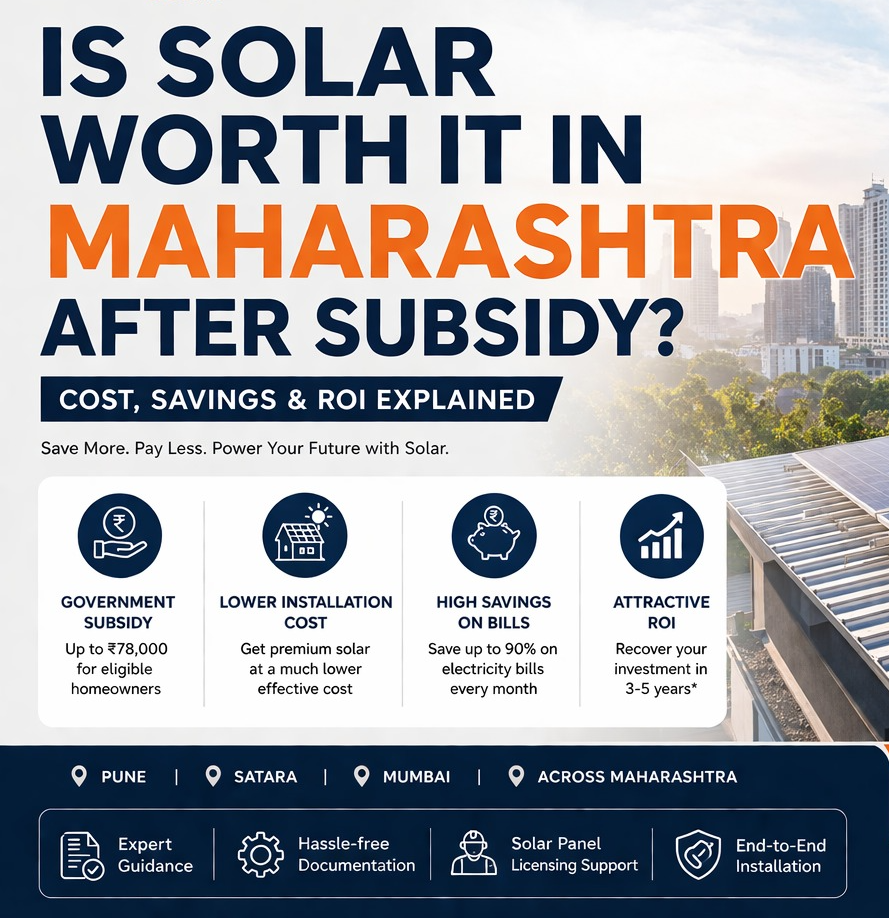
Solar Subsidy in Maharashtra: Cost, Savings & ROI
Installing rooftop solar has become one of the smartest investments for homeowners and businesses across Maharashtra. With rising electricity tariffs and generous government incentives, many people are asking: Is solar really worth it after subsidy? The short answer is yes. With the right system, the solar subsidy in Maharashtra can significantly reduce your upfront investment, shorten your payback period, and deliver substantial long-term savings. Whether you live in Pune, Satara, Mumbai, or anywhere else in Maharashtra, rooftop solar can help you lower electricity bills while increasing your energy independence.
In this guide, we’ll break down the actual costs, available subsidies, expected savings, and return on investment (ROI) so you can make an informed decision.
Why Solar Is Gaining Popularity in Maharashtra
Maharashtra is one of India’s leading states for solar adoption. The reasons are clear:
- Abundant sunlight throughout the year
- Rising grid electricity costs
- Attractive central government incentives
- Growing awareness of sustainable energy
- Faster payback due to improved solar technology
Cities like Pune, Mumbai, and Satara are seeing rapid growth in residential and commercial rooftop solar installations. Thanks to the Maharashtra government solar subsidy and national renewable energy initiatives, solar is now more affordable than ever.
What Is the Solar Subsidy in Maharashtra?
The solar panel subsidy Maharashtra homeowners receive primarily comes under the Central Financial Assistance (CFA) scheme, popularly linked with the PM Surya Ghar initiative. This is often referred to as the central government solar subsidy.
Current Subsidy Structure for Residential Rooftop Solar
- Up to 2 kW: Subsidy available per kW installed
- 2 kW to 3 kW: Additional subsidy for the extra capacity
- Maximum subsidy capped at 3 kW systems
This government solar subsidy substantially reduces the initial installation cost, making rooftop solar accessible for middle-income households.
The solar subsidy in Maharashtra is provided under the central government rooftop solar scheme. Residential users can receive financial assistance for systems up to 3 kW, significantly reducing the upfront installation cost.
How Much Does Rooftop Solar Cost in Maharashtra After Subsidy?
The cost of a rooftop solar system depends on system size, panel quality, inverter type, and installation complexity.
Approximate Residential Solar System Costs
- 1 kW system: Ideal for small homes
- 2 kW system: Suitable for moderate electricity consumption
- 3 kW system: Best for average families
- 5 kW system: Ideal for larger homes or higher usage
After applying the rooftop solar subsidy in Maharashtra, the effective cost can reduce significantly, often by 20–35% for eligible residential customers.
Estimated Savings on Electricity Bills
One of the biggest benefits of solar is the long-term savings.
Typical Monthly Savings
- 1 kW system: Reduces a portion of monthly electricity bills
- 2 kW system: Significant savings for small families
- 3 kW system: Major reduction for average households
- 5 kW system: Can offset most residential electricity usage
In cities like Pune and Mumbai, where electricity tariffs are relatively high, the savings can be even more attractive.
ROI: How Quickly Does Solar Pay for Itself?
The payback period for residential rooftop solar in Maharashtra is typically:
- 4 to 6 years with subsidy
- 6 to 8 years without subsidy
Since solar panels generally last 25 years or more, homeowners enjoy nearly two decades of low-cost electricity after recovering their investment.
Example ROI Calculation for a 3 kW System
- Initial investment after subsidy: Lower upfront cost
- Annual electricity savings: Significant recurring savings
- Payback period: Around 4–5 years
- Total lifetime savings: Substantial long-term returns
This makes solar one of the most reliable and high-return home upgrades available today.
Key Factors That Affect Solar ROI in Maharashtra
1. Roof Space and Sunlight Availability: A shadow-free roof ensures maximum energy generation.
2. Electricity Consumption: Higher consumption usually leads to faster payback.
3. Net Metering Benefits: Excess electricity exported to the grid can further improve savings.
4. Quality of Components: Premium solar panels and inverters offer better efficiency and longevity.
5. Professional Installation: Proper design and installation maximize system performance.
Government Solar Scheme for Home: What You Need to Know
The government solar scheme for home is designed to encourage residential solar adoption through subsidies, simplified approvals, and net metering support.
Benefits include:
- Reduced upfront investment
- Lower electricity bills
- Protection against tariff hikes
- Environmentally friendly power generation
- Increased property value
Solar Panel Licensing and Approval Process in Maharashtra
Installing rooftop solar involves certain approvals and documentation. This is where understanding solar panel licensing becomes essential.
The process generally includes:
- Site assessment and system design
- Application submission to the DISCOM
- Technical approval
- Installation by an authorized vendor
- Inspection and net meter installation
- Commissioning and subsidy claim processing
Working with an experienced installer simplifies the entire process.
Is Solar Worth It in Pune, Mumbai, and Satara?
Absolutely. These cities offer ideal conditions for rooftop solar.
Pune
- Strong solar irradiance
- High residential adoption
- Excellent ROI potential
Mumbai
- High electricity tariffs increase savings
- Rooftop solar helps reduce dependence on grid power
Satara
- Excellent sunlight availability
- Ideal for both residential and agricultural applications
Who Should Consider Rooftop Solar?
Rooftop solar is ideal for:
- Homeowners with regular daytime electricity usage
- Families with monthly bills above average levels
- Villas, bungalows, and independent homes
- Housing societies exploring shared solar solutions
- Businesses seeking long-term energy savings
Frequently Asked Questions
How much solar subsidy is available in Maharashtra?
Residential consumers can receive subsidy for rooftop solar systems up to 3 kW under the central government scheme.
Is solar profitable after subsidy?
Yes. Most homeowners recover their investment within 4 to 6 years and enjoy decades of savings.
Can I get both a state and central subsidy?
Currently, the primary financial assistance is offered through the central government solar subsidy scheme.
What documents are required for solar subsidy?
Typically, you need identity proof, property documents, electricity bill, and bank account details.
Do I need approval before installing solar panels?
Yes, approvals from the local DISCOM are required for grid-connected rooftop solar systems.
Conclusion: Is Solar Worth It in Maharashtra?
Without a doubt, yes. With rising electricity prices, abundant sunlight, and the availability of the solar subsidy in Maharashtra, rooftop solar offers outstanding financial and environmental benefits.
For homeowners in Pune, Mumbai, Satara, and across Maharashtra, solar is no longer just an eco-friendly choice; it’s a smart financial investment.
With a typical payback period of just 4–6 years and system life of over 25 years, the returns are hard to ignore.
Ready to Go Solar?
At S’unlimited Solar, we help homeowners and businesses navigate every step – from system design and installation to government solar subsidy, approvals, net metering, and licensing.
If you’re planning to install rooftop solar in Maharashtra, our team can help you maximize savings and ensure a hassle-free experience.
Contact S’unlimited Solar today to explore the right solar solution for your home or business.

Pournima
A content writer at S'unlimited with expertise in solar energy education, producing guides and insights that simplify complex industry concepts for homeowners and businesses.