
How Much Roof Space Is Required for Commercial Rooftop Solar Installation?
Commercial Rooftop Solar Installation: Roof Space Guide
When businesses consider switching to solar, one of the first questions they ask is: how much roof space is actually needed? It’s a practical question, and an important one. After all, your available rooftop area directly influences the size, capacity, and energy output of your solar system.
A well-planned commercial rooftop solar installation can significantly reduce electricity costs, improve energy independence, and support your sustainability goals. But before investing, it’s essential to understand how roof space requirements are calculated and what factors affect system design.
Why Roof Space Matters in Commercial Solar Projects
The size of your rooftop determines how many solar panels can be installed and, ultimately, how much electricity your system can generate. For businesses, this directly impacts:
- Potential energy savings
- Return on investment (ROI)
- System capacity
- Long-term sustainability benefits
Whether you’re planning a small office setup or a large industrial rooftop solar power plant, optimizing roof space is the foundation of an efficient solar project.
How Much Roof Space Is Needed?
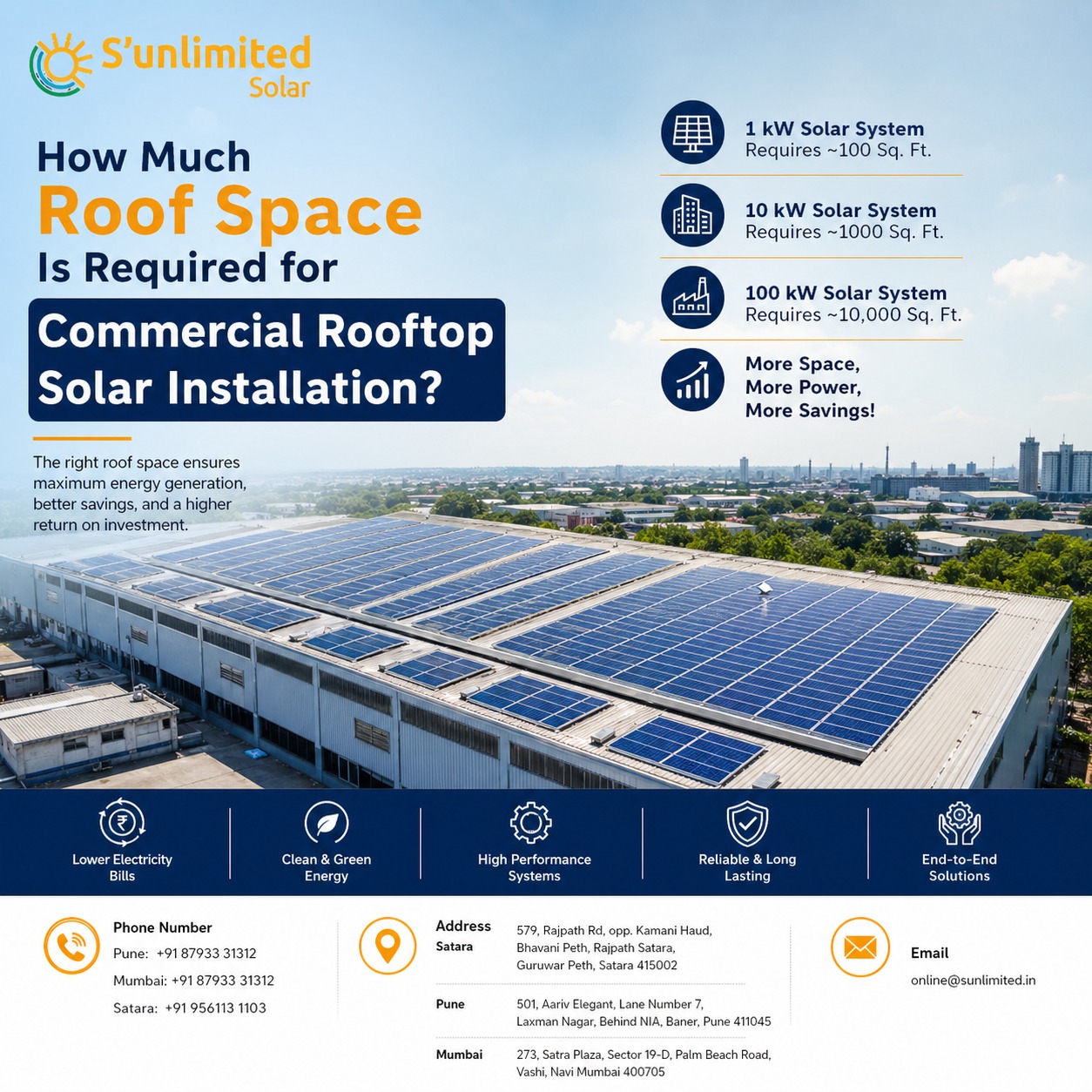
As a general rule, a commercial rooftop solar installation requires approximately:
- 80–100 square feet per kW for standard systems
- 70–90 square feet per kW when using high-efficiency panels
This includes space for panel placement, maintenance access, and structural clearances.
Quick Reference Guide
- 10 kW system: 800–1,000 sq. ft.
- 50 kW system: 4,000–5,000 sq. ft.
- 100 kW system: 8,000–10,000 sq. ft.
- 500 kW system: 40,000–50,000 sq. ft.
- 1 MW system: 80,000–100,000 sq. ft.
These figures may vary depending on panel efficiency, mounting structure, and site conditions.
Factors That Affect Roof Space Requirements
1. Solar Panel Efficiency: High-efficiency panels generate more power in less space. This is particularly beneficial for buildings with limited roof area.
2. Roof Type and Layout: Flat roofs generally offer greater flexibility in panel placement. Sloped roofs may require additional spacing for optimal orientation and shading avoidance.
3. Obstructions on the Roof: Equipment such as HVAC units, water tanks, vents, skylights, and access pathways reduce usable installation area.
4. Panel Orientation and Tilt: To maximize energy generation, panels must be positioned at the ideal tilt and orientation. This can affect spacing between rows.
5. Structural Load Capacity: The roof must be able to support the additional weight of solar panels and mounting systems. A structural assessment is always recommended.
Typical Applications by Business Type
Offices and Commercial Buildings: Ideal for reducing daytime electricity consumption and lowering operating expenses.
Warehouses and Logistics Centers: Large, unobstructed rooftops make them excellent candidates for commercial rooftop solar solutions.
Manufacturing Facilities: Industrial solar panel installation can offset high energy demands and improve operational efficiency.
Educational Institutions and Hospitals: Solar offers long-term savings while supporting sustainability initiatives.
Benefits of Maximizing Rooftop Space
- Lower electricity bills
- Faster payback period
- Better energy independence
- Reduced carbon footprint
- Improved ESG performance
- Protection against rising energy costs
A properly designed system transforms unused roof space into a valuable energy-generating asset.
Can Your Roof Support a Solar Installation?
Before proceeding, a professional solar assessment should evaluate:
- Available shadow-free area
- Roof condition and age
- Structural strength
- Electrical infrastructure compatibility
- Annual energy consumption patterns
This ensures the proposed system is both technically feasible and financially viable.
Choosing the Right Solar Capacity
The ideal system size depends on:
- Your monthly electricity consumption
- Available roof space
- Budget and investment goals
- Future energy requirements
An experienced provider can help match your energy needs with the optimal system capacity.
Why Choose S’unlimited Solar?
S’unlimited Solar specializes in customized commercial solar energy solutions for businesses across industries. From site assessment and design to installation and maintenance, our team delivers end-to-end expertise tailored to your facility.
Our solutions are designed to:
- Maximize rooftop utilization
- Optimize energy generation
- Deliver strong ROI
- Ensure long-term reliability
Whether you need a small commercial system or a large-scale industrial rooftop solar power plant, we provide solutions built for performance.
Conclusion
Understanding roof space requirements is the first step toward a successful commercial rooftop solar installation. With proper planning, even underutilized rooftops can become powerful energy assets.
If you’re considering solar for your business, a professional site assessment can help determine the right system size, expected savings, and return on investment.
Ready to unlock the potential of your rooftop? Contact us today to explore customized commercial rooftop solar solutions for your business.

Pournima
A content writer at S'unlimited with expertise in solar energy education, producing guides and insights that simplify complex industry concepts for homeowners and businesses.