
How Long Does It Take to Receive Solar Subsidy Benefits in Maharashtra?

Solar Subsidy in Maharashtra: When Will You Receive It?
As electricity costs continue to rise, many homeowners across Maharashtra are turning to rooftop solar systems to reduce their monthly power bills and become more energy independent. Government-backed subsidy programs have made solar installations more affordable, encouraging thousands of households to switch to clean energy.
However, one question frequently asked by homeowners is: “How long does it take to receive solar subsidy benefits in Maharashtra?”
The answer depends on several factors, including documentation, approvals, installation quality, and subsidy processing procedures. Understanding the timeline can help homeowners plan their investment and avoid unnecessary delays.
In this guide, we’ll explain the typical subsidy process, expected timelines, and factors that affect when you receive your subsidy benefits.
Why Solar Subsidies Are Important
The solar subsidy in Maharashtra helps reduce the upfront cost of installing a rooftop solar system. With support from government initiatives, homeowners can make the transition to solar energy more affordable and achieve faster returns on investment.
Benefits of subsidy-supported solar installations include:
- Lower installation costs
- Reduced electricity bills
- Faster payback period
- Increased property value
- Long-term energy savings
Combined with Maharashtra’s abundant sunlight, solar energy becomes an attractive option for residential properties.
Understanding the Solar Subsidy Process
Before discussing timelines, it’s important to understand the steps involved in receiving subsidy benefits.
The process generally includes:
- Site survey and system design
- Application submission
- Installation of the rooftop solar system
- Inspection and verification
- Net metering approval
- Subsidy claim processing
- Subsidy disbursement
Each stage contributes to the overall timeline.
Step 1: Site Survey and Project Planning
The process begins with an assessment of your property.
Solar experts evaluate:
- Roof size and condition
- Electricity consumption
- Available sunlight
- System capacity requirements
This stage usually takes a few days and helps determine the most suitable solar solution.
Step 2: Documentation and Application
To qualify for a government solar subsidy, homeowners must submit the required documents.
Commonly required documents include:
- Aadhaar Card
- Address proof
- Electricity bill
- Property ownership documents
- Bank account details
- Passport-size photograph
Submitting complete and accurate information is one of the most important factors in avoiding delays.
Step 3: Rooftop Solar Installation
Once approvals and documentation are initiated, the installation process begins.
A typical residential system may take:
- 1–3 days for smaller systems
- Several days for larger installations
The timeline depends on system size and site conditions.
Step 4: Inspection and Verification
After installation, the system must be inspected to verify:
- Safety standards
- Installation quality
- Technical compliance
- System specifications
Inspection timelines may vary depending on local utility schedules and application volumes.
Step 5: Net Metering Approval
Net metering allows homeowners to export excess solar energy to the electricity grid.
The approval process generally includes:
- Technical review
- Meter inspection
- Utility verification
- Final approval
This step is often one of the most time-sensitive parts of the process.
Step 6: Subsidy Processing
Once installation and verification are completed, subsidy claims are processed through the applicable channels.
The review may involve:
- Document verification
- Eligibility checks
- Installation validation
- Compliance review
Applications that contain complete and accurate information generally move through the process more efficiently.
So, How Long Does It Usually Take?
Although timelines can vary, many residential solar projects follow a process similar to the following:
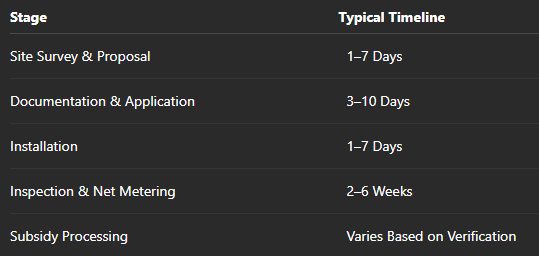
The overall timeframe depends on project readiness, utility approvals, and government processing schedules.
Factors That Can Delay Subsidy Benefits
Several issues may increase processing time.
- Incomplete Documentation: Missing information is one of the most common reasons for delays.
- Incorrect Application Details: Errors in customer information or technical documents can slow down approvals.
- Utility Approval Delays: Net metering and inspection timelines vary by location and application volume.
- Non-Compliant Installations: Systems that do not meet required standards may require corrective action before subsidy processing continues.
Government Schemes Supporting Solar Adoption
India continues to encourage residential solar adoption through various initiatives.
Programs such as the government solar scheme for home and central government solar subsidy programs help make rooftop solar more accessible for homeowners.
These initiatives are designed to:
- Increase renewable energy adoption
- Reduce dependence on conventional electricity
- Support sustainable development
- Encourage energy independence
Solar Subsidy and Licensing: Understanding the Difference
Many homeowners confuse subsidy benefits with approval procedures.
While subsidy programs provide financial assistance, solar panel licensing and utility approvals ensure that installations comply with technical and safety standards.
A complete project often involves:
- Documentation submission
- Utility approvals
- Net metering procedures
- Technical verification
Professional support can help simplify these requirements.
Why More Homeowners Are Applying in 2026
Interest in rooftop solar subsidy in Maharashtra continues to grow because homeowners recognize the long-term financial advantages of solar energy.
Key reasons include:
- Rising electricity prices
- Improved solar technology
- Government support programs
- Growing environmental awareness
- Attractive return on investment
As adoption increases, early planning becomes even more important.
Why Choose S’unlimited Solar?
S’unlimited Solar provides complete support for homeowners looking to install rooftop solar systems and navigate government procedures.
Our services include:
- Site assessment
- Solar system design
- Installation support
- Documentation assistance
- Net metering guidance
- Government procedure support
Conclusion
The time required to receive solar subsidy in Maharashtra benefits depends on documentation accuracy, installation quality, utility approvals, and subsidy verification procedures. While timelines can vary, homeowners who prepare the required documents and work with experienced solar professionals can significantly reduce delays.
With government support programs making solar more affordable than ever, 2026 is an excellent time to invest in rooftop solar and start enjoying long-term energy savings.
Ready to start your solar journey? Contact S’unlimited Solar today for expert guidance on solar subsidies, licensing procedures, and rooftop solar installation.

Pournima
A content writer at S'unlimited with expertise in solar energy education, producing guides and insights that simplify complex industry concepts for homeowners and businesses.