
How to Evaluate Solar Panels for Commercial Use: A Technical Checklist for C&I Projects
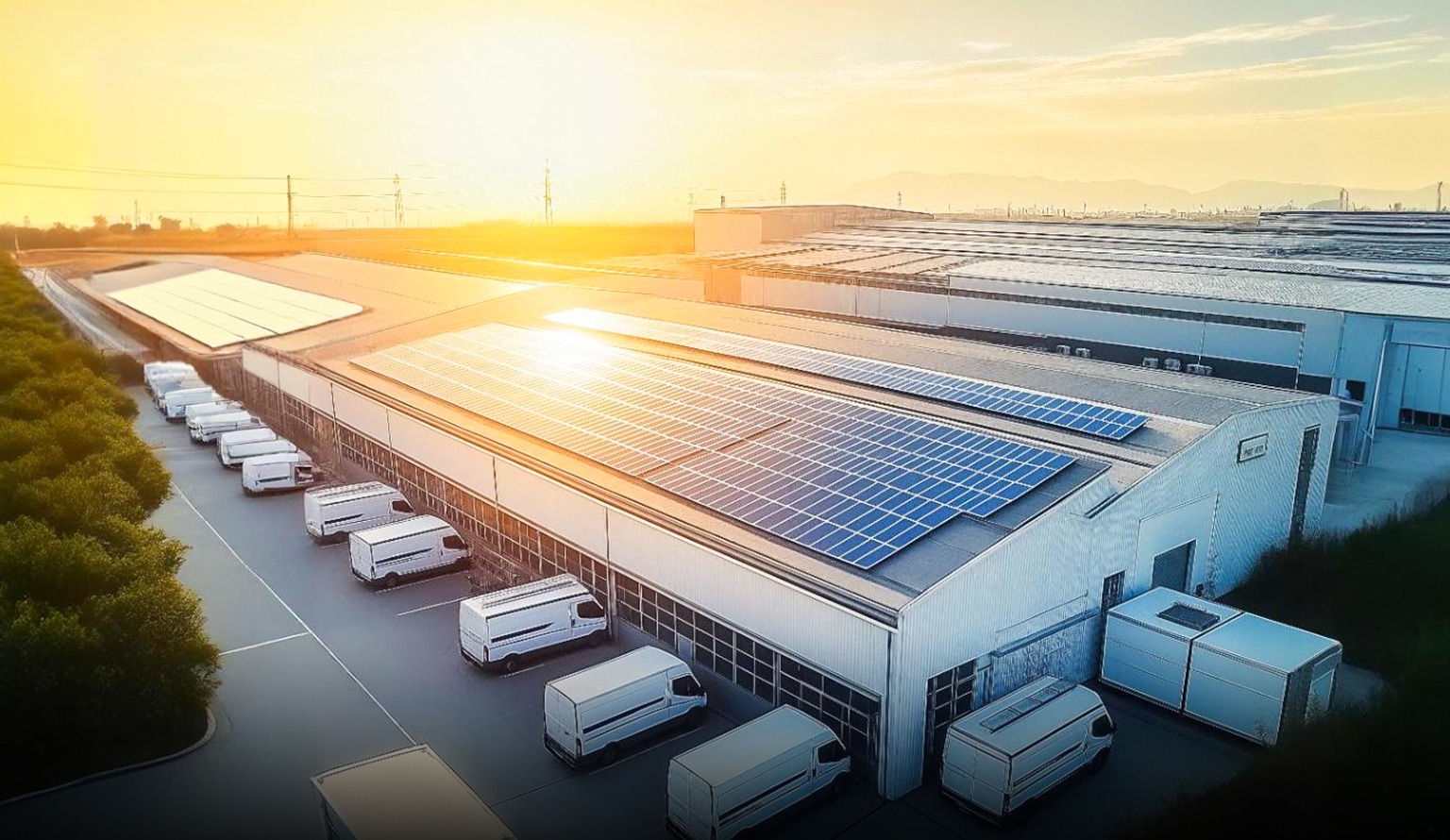
Solar Panel for Commercial Use: C&I Evaluation Checklist
Most content on commercial solar stops at “compare a few quotes and pick one.” For a genuine commercial and industrial (C&I) project – whether it’s a factory floor, a warehouse, or a multi-tenant commercial building – that approach misses the technical due diligence that actually determines whether a solar panel for commercial use delivers its projected returns or quietly underperforms for two decades.
This isn’t a beginner’s guide to “why solar saves money.” It’s a working checklist for facility managers, plant heads, and business owners who need to evaluate a proposed system on its technical merits – module specifications, energy audit rigor, feasibility assumptions, EPC scope, and O&M structure – before signing a contract.
At S’unlimited Solar, we work as an EPC and solutions partner across residential, commercial, and industrial rooftop projects, coordinating design, installation, and long-term performance rather than manufacturing panels ourselves. This checklist reflects the same evaluation framework we use internally when scoping a commercial rooftop solar installation.
What Should a Proper Energy Audit Cover Before Sizing a C&I System?
A system sized without a real audit is a system sized on guesswork. For any business solar panel installation, the audit should go beyond a single month’s bill.
A technically sound energy audit typically covers:
- 12 months of interval or TOD (time-of-day) consumption data, not just aggregate monthly units, to capture load shape against solar generation hours
- Peak demand (kVA) and load factor analysis, since sanctioned load and contract demand directly cap your eligible system size under most DISCOM rules
- Seasonal and production-cycle variation, especially for factories running multi-shift or seasonal batch operations
- Power quality baseline, including harmonic distortion and voltage fluctuation, which affects inverter selection and grid compliance
- Existing captive generation or DG set usage, which changes the economic case and sometimes the interconnection approach
Direct answer: A proper C&I energy audit should be based on at least 12 months of actual interval consumption data, sanctioned load, and peak demand – not a single bill or a generic per-square-foot estimate.
How Is Technical Feasibility Different From a Basic Site Visit?
A feasibility study for C&I solar is an engineering exercise, not a walkthrough with a tape measure.
What a rigorous feasibility assessment includes:
- Structural load assessment of the roof or ground-mount area, factoring in existing dead load, live load allowances, and local wind-load codes
- Shading analysis across the annual sun path, not just a single-day observation, since shading from adjacent structures shifts seasonally
- Available contiguous area vs. usable area, after accounting for fire safety clearances, walkways, and existing rooftop equipment (HVAC units, water tanks, skylights)
- Grid interconnection feasibility, including transformer capacity, available feeder headroom, and whether net or gross metering applies at your sanctioned load tier
- Soil and foundation assessment, for ground-mounted or elevated structure installations on industrial land
Did You Know? For older industrial roofs – particularly asbestos or aging metal sheet roofing common in many factory sheds – structural reinforcement needs are one of the most frequently underestimated cost items in early-stage commercial solar quotes, precisely because they’re only caught during a proper structural assessment rather than a visual walkthrough.
Quick Tip: Ask your EPC partner to share the actual load calculation and shading report as documents, not just a summary conclusion – this is a fair, standard request for any serious industrial solar installation proposal.
What Module Specifications Actually Matter for C&I Projects?
Not every efficiency figure on a datasheet is equally relevant to your project. For C&I buyers evaluating a solar panel for commercial use, these are the specifications worth scrutinizing:
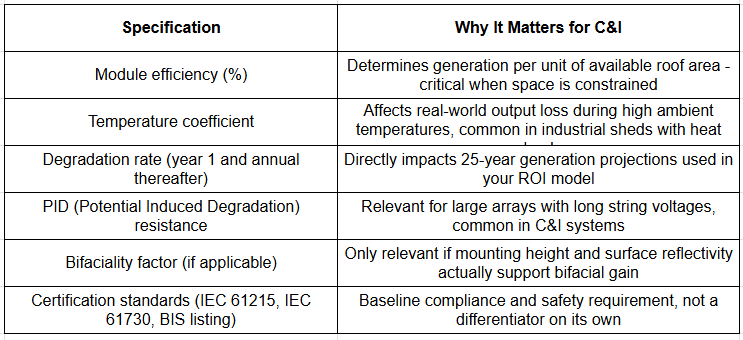
Direct answer: For commercial and industrial rooftops, temperature coefficient and annual degradation rate typically matter more to long-term output than headline efficiency percentage alone, since C&I sites often run hotter and are evaluated over a full 25-year financial model.
How Should System Design Account for Load Profile, Not Just Roof Area?
This is where many C&I quotes go wrong – sizing to available roof space rather than to how the business actually consumes power.
Key design questions to ask your EPC partner:
- Is the proposed system size matched to your daytime consumption baseline, or simply to maximum available roof area?
- How is the string and inverter configuration designed to minimize losses from partial shading across different times of day and year?
- What inverter topology is proposed – string inverters vs. central inverters – and how does that decision align with your roof layout and maintenance preferences?
- Is DC-AC ratio (oversizing factor) optimized for your specific irradiance profile, or using a generic default?
- Does the design account for future load growth or expansion plans, in terms of both electrical infrastructure and physical space?
Ask yourself: Has your proposed system size been justified against your actual load curve, or simply presented as “the maximum that fits your roof”? These can lead to very different financial outcomes.
What Should Be Included in an EPC Scope of Work for a C&I Project?
A comprehensive commercial solar installation company scope of work should be explicit about deliverables, not just “installation.”
A properly defined EPC scope typically covers:
- Engineering – detailed system design, structural drawings, single-line diagrams, and load calculations
- Procurement – module, inverter, and balance-of-system (BOS) component sourcing against specified standards
- Civil and structural work – mounting structure fabrication and installation, including any roof reinforcement
- Electrical installation – DC and AC wiring, protection systems, earthing, and lightning protection
- Grid interconnection – liaison with the DISCOM for net/gross metering approval and load sanction verification
- Commissioning and testing – performance ratio verification, thermal imaging checks, and safety compliance testing
- Documentation handover – as-built drawings, warranty certificates, and compliance documentation
Did You Know? Incomplete EPC scope definitions – particularly around who handles DISCOM liaison and structural reinforcement – are among the most common sources of disputes and cost overruns in C&I solar projects, simply because these items weren’t explicitly assigned in the original contract.
How Should O&M Be Structured for a Commercial or Industrial Plant?
Operation and maintenance for C&I systems needs a different cadence and depth than residential upkeep, given the scale of financial exposure.
What a proper C&I O&M plan should specify:
- Cleaning frequency, calibrated to local dust, pollution, or industrial particulate exposure rather than a generic schedule
- Performance monitoring granularity – string or panel-level monitoring for larger arrays, not just plant-level aggregate output
- Response time SLAs for fault resolution, particularly important given the larger absolute financial impact of downtime at industrial scale
- Preventive maintenance schedule covering inverter health checks, thermal scans for hotspot detection, and connector/junction box inspection
- Performance guarantee terms, if offered, and how shortfalls against guaranteed generation are handled contractually
Quick Tip: Ask specifically what performance ratio (PR) your O&M provider targets and reports against – a defined, tracked PR benchmark is a stronger signal of a serious O&M program than a vague “we’ll keep it running” assurance.
Checklist: Technical Due Diligence Before Signing a C&I Solar Contract
- Has your energy audit used 12 months of interval or TOD consumption data, not a single bill?
- Has structural load and shading analysis been documented, not just verbally summarized?
- Have module specifications (temperature coefficient, degradation rate, certification) been shared in writing?
- Is system sizing justified against your load profile, not just available roof area?
- Does the EPC scope explicitly define engineering, procurement, civil, electrical, and DISCOM liaison responsibilities?
- Is the O&M plan specific about cleaning frequency, monitoring granularity, and fault response SLAs?
- Are financing model, depreciation eligibility, and grid connection type (net/gross metering) clearly specified?
Common Technical Oversights in C&I Solar Evaluation
- Sizing based on roof area rather than load profile, resulting in systems that don’t align with actual consumption patterns.
- Accepting a single-day shading observation instead of a full annual sun-path shading analysis.
- Overlooking structural reinforcement needs on older industrial roofing, discovered only after contract signing.
- Treating EPC scope as implicit rather than explicitly documented, leading to disputes over who handles DISCOM liaison or civil work.
- Comparing modules on efficiency percentage alone, without evaluating temperature coefficient or degradation rate relevant to actual site conditions.
- Underspecifying O&M terms, assuming “maintenance included” covers the same scope across different providers.
Why This Level of Evaluation Matters for Project ROI
A solar for warehouses or factory installation is typically evaluated on a financial model spanning 20-25 years. Technical assumptions made at the audit and design stage – load profile accuracy, degradation rate, shading losses, DC-AC ratio – compound significantly over that period. A system designed against a rigorous audit and documented feasibility study consistently outperforms one sized against rough estimates, even when using identical equipment.
Quick Tip: Request a generation projection (P50/P90) from your EPC partner rather than a single average annual figure – this shows the confidence range around expected output and reflects a more rigorous engineering approach.
When Should You Bring In a Solar EPC Partner for Technical Evaluation?
Engage a technical solar consultant or EPC partner early if:
- You’re evaluating multiple proposals and need to compare them on technical merit, not just headline price.
- Your facility has structural, shading, or layout constraints that a generic quote wouldn’t have assessed.
- You’re planning a phased or multi-site rollout and need a consistent technical evaluation framework.
- Your existing energy audit is based on limited data (a single bill or estimate) rather than interval consumption.
- You want an independent technical review of a proposal before signing an EPC contract.
FAQs
1. What’s the difference between a basic solar quote and a proper C&I feasibility study? A basic quote typically estimates system size from roof area and a single electricity bill. A proper feasibility study includes structural load assessment, annual shading analysis, grid interconnection review, and system sizing based on 12 months of interval consumption data.
2. How does module temperature coefficient affect a commercial installation? Temperature coefficient indicates how much a module’s output drops as operating temperature rises above standard test conditions. Industrial rooftops, especially metal sheds, often run hotter than ambient temperature, making this specification directly relevant to real-world generation, not just theoretical output.
3. What should be included in an EPC contract for commercial rooftop solar installation? A complete EPC contract should explicitly define engineering and design, procurement standards, civil and structural work, electrical installation, DISCOM liaison for grid connection, commissioning testing, and documentation handover.
4. How is O&M different for industrial solar power plants compared to residential systems? Industrial O&M typically requires more frequent cleaning cycles, panel or string-level monitoring, defined fault response SLAs, and performance ratio tracking, given the larger absolute financial impact of underperformance at industrial scale.
5. Why does DC-AC ratio matter in commercial solar system design? The DC-AC ratio (or inverter loading ratio) affects how efficiently the system captures generation across varying irradiance conditions throughout the day. An improperly optimized ratio for your specific site can either waste potential generation or unnecessarily increase equipment cost.
6. Can solar panels for factory rooftops be installed on older or asbestos roofing? It depends on the structural condition of the existing roof. A proper structural assessment determines whether reinforcement or a different mounting approach is needed before installation on older industrial roofing.
7. What does a P50/P90 generation estimate mean, and why does it matter? P50 represents the generation estimate expected to be met or exceeded 50% of the time, while P90 represents a more conservative estimate expected to be met 90% of the time. Requesting both gives a more realistic risk-adjusted view of expected performance than a single average figure.
8. How do I evaluate whether a commercial solar installation company’s O&M plan is adequate? Ask for specifics: cleaning frequency, monitoring granularity (string or panel-level), fault response SLAs, and whether performance ratio is tracked and reported against a defined benchmark, rather than accepting a general “maintenance included” statement.
Conclusion
Evaluating a solar panel for commercial use at a technical level – energy audit rigor, feasibility documentation, module specifications relevant to your site conditions, explicit EPC scope, and a properly structured O&M plan – is what separates a C&I solar investment that performs as modeled from one that quietly underdelivers against its projected ROI. Roof area and a single quoted price are starting points, not sufficient due diligence for a 20-25 year asset.
For facility managers and business owners evaluating industrial solar power plant or commercial rooftop proposals, this checklist offers a working framework to assess technical merit before committing to a contract.
Ready for a Technical Evaluation of Your Facility’s Solar Potential?
S’unlimited Solar works as your EPC and solutions partner – coordinating energy audits, feasibility studies, system design, installation, and O&M for commercial and industrial projects.
Request a technical consultation and site assessment today →
Get an evaluation based on engineering rigor, not rough estimates – with zero obligation.

Pournima
A content writer at S'unlimited with expertise in solar energy education, producing guides and insights that simplify complex industry concepts for homeowners and businesses.