
Choosing the Right Solar Panels for Commercial Use: Efficiency vs Cost
Solar Panel for Commercial Use: Efficiency vs Cost
When a business owner starts comparing quotes for a solar panel for commercial use, the first thing that usually stands out is price – and understandably so, since commercial systems involve significantly more panels than a typical home installation. But price alone can be a misleading starting point, because two panels with very different costs can deliver very different long-term value once efficiency, degradation rates, and available roof space enter the picture.
The real question isn’t “which panel is cheapest?” It’s “which panel delivers the best return for my specific roof space, budget, and consumption needs?” Sometimes that’s the cheaper option. Often, it isn’t.
This blog breaks down exactly how efficiency and cost trade off against each other for commercial installations, so you can make a decision based on actual long-term value, not just the number at the bottom of a quote.
Quick Answer: Efficiency or Cost – Which Matters More for Commercial Solar?
For most commercial rooftop solar installation projects, the right answer depends on your available roof space relative to your energy needs:
- Limited roof space, high energy needs: Prioritize higher-efficiency panels, since they generate more power per square foot, even at a higher upfront cost.
- Ample roof space, moderate energy needs: Lower-cost, standard-efficiency panels often deliver better overall ROI, since you can install more panels without space constraints.
Quick Tip: Before comparing panel types, calculate your available roof or land area against your target system size in kW – this single number often determines which side of the efficiency-vs-cost trade-off matters more for your business.
Understanding Solar Panel Efficiency for Commercial Use
Efficiency refers to how much of the sunlight hitting a panel actually converts into usable electricity. Higher efficiency panels generate more power from the same physical panel size.
Common panel types and their general efficiency range:
- Polycrystalline panels – Generally lower efficiency, typically the most budget-friendly option
- Monocrystalline panels – Higher efficiency, moderate to premium pricing
- Monocrystalline PERC panels – Enhanced efficiency through improved cell technology, priced at a premium
- Bifacial panels – Capture sunlight from both sides, offering additional generation potential in suitable installations, typically priced higher
Did You Know? Higher efficiency doesn’t just mean more power – it also means you can achieve your target system capacity using fewer panels, which can reduce mounting structure, wiring, and labour costs, partially offsetting the higher per-panel price.
Why Cost Alone Can Be a Misleading Metric
A lower price per panel doesn’t automatically mean a lower total cost per kW of installed capacity – and it definitely doesn’t guarantee better long-term value.
What “cost” should actually account for:
- Price per panel vs price per kW of capacity
- Number of panels needed to reach your target system size
- Additional mounting structure and wiring costs for larger panel counts
- Expected degradation rate over the panel’s lifespan
- Warranty terms and manufacturer reliability
Ask yourself: Are you comparing panels based on price per unit, or price per kW of actual generating capacity? These can lead to very different conclusions about which option is genuinely more cost-effective.
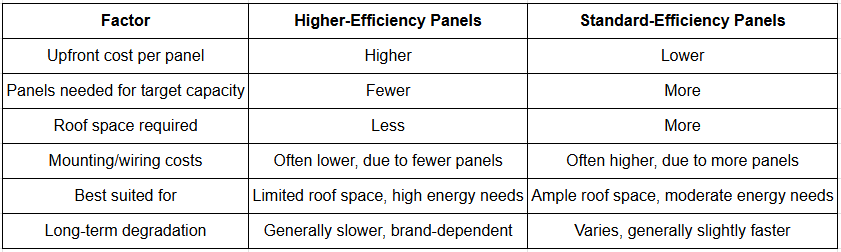
Comparison Table: Efficiency vs Cost Trade-offs
Real-World Example: Same Budget, Different Roof Constraints
Consider two businesses in Pune, each with a similar budget for a 50kW industrial rooftop solar power plant.
Business A has a large, unobstructed warehouse roof with ample space. Choosing standard-efficiency panels allowed them to reach their target capacity while staying well within budget, since space wasn’t a limiting factor.
Business B has a smaller commercial rooftop with several existing installations – HVAC units, water tanks – reducing usable area. For this business, higher-efficiency panels were the more practical choice, since achieving the same 50kW capacity within limited space required maximizing generation per square foot, even at a higher per-panel cost.
Both businesses made the right choice for their specific situation – the efficiency-vs-cost decision genuinely depends on your available space, not a universal “better” option.
How Panel Degradation Affects Long-Term Value
Solar panels naturally lose a small percentage of their efficiency each year – this is normal and expected. But degradation rates vary between panel types and manufacturers, and this matters significantly for commercial solar energy solutions evaluated over a 20-25 year lifespan.
What to check:
- Manufacturer’s stated degradation rate per year
- Performance warranty terms (typically guaranteeing a certain percentage of original output after 25 years)
- Real-world performance data from similar installations, if available
Quick Tip: A panel with a slightly lower efficiency rating but a stronger degradation warranty can sometimes outperform a higher-efficiency panel with weaker long-term guarantees, when evaluated over the system’s full lifespan.
Beyond the Panel: Other Factors That Affect Commercial Solar ROI
Panel choice is important, but it’s only one piece of the overall cost-efficiency equation for industrial solar panel installation projects.
- Inverter efficiency – A high-quality inverter matched correctly to your system size significantly affects overall energy conversion
- Mounting structure quality – Affects long-term durability and maintenance costs, particularly relevant given roof exposure to weather over decades
- Installation and engineering quality – Proper shading analysis and string design can matter as much as panel efficiency itself
- Ongoing maintenance – Regular cleaning and servicing protect your panels’ actual performance against their rated efficiency
Did You Know? Even the most efficient panels available will underperform their rated capacity if installation design – shading analysis, string layout, structural mounting – isn’t done properly. Panel choice and installation quality work together, not independently.
Common Mistakes Businesses Make When Choosing Commercial Panels
- Comparing price per panel instead of price per kW of capacity, leading to misleading cost comparisons.
- Choosing the cheapest panels without checking available roof space constraints first.
- Ignoring degradation rates and warranty terms, focusing only on initial efficiency numbers.
- Assuming higher efficiency is always worth the premium, even when roof space isn’t a limiting factor.
- Overlooking inverter quality and installation design, which significantly affect real-world panel performance.
- Not requesting a cost-per-kW breakdown when comparing quotes from different installers.
Checklist: How to Choose the Right Panel for Your Business
- Have you calculated your available roof or land space relative to your target system capacity?
- Are you comparing panels based on cost per kW, not just cost per unit?
- Have you checked degradation rates and performance warranty terms for each panel option?
- Does your installer explain how panel choice affects total mounting and wiring costs?
- Have you factored in inverter quality and installation design alongside panel selection?
- Do you have a clear understanding of which option delivers better long-term ROI for your specific roof constraints?
ROI Insight: Why the “Right” Panel Depends on Your Situation, Not a Universal Answer
There’s no single best panel type for every solar panel for commercial use scenarios. A business with abundant roof space often achieves better ROI with cost-effective, standard-efficiency panels, simply by installing more of them. A business with limited space often needs higher-efficiency panels to reach the same capacity, making the premium cost worthwhile.
Quick Tip: Ask your installer to model out two or three panel options against your specific roof space and target capacity, showing total cost, expected annual generation, and estimated payback period for each – this comparison reveals the right choice far more clearly than efficiency percentages or price tags alone.
When Should You Contact a Solar Expert?
Reach out to a commercial solar consultant if:
- Your available roof or land space is limited relative to your energy needs.
- You’re comparing quotes with significantly different panel types and unsure how to evaluate them fairly.
- You want a cost-per-kW comparison rather than a per-panel price comparison.
- You’re planning a large industrial installation and need help balancing efficiency, cost, and available space.
- You want to understand how degradation rates and warranty terms affect long-term value.
A detailed consultation can help you avoid choosing based on price or efficiency alone, and instead select the option that genuinely fits your specific property and goals.
FAQs
1. Are higher-efficiency solar panels always better for commercial use? Not necessarily. Higher-efficiency panels are most valuable when roof space is limited, since they generate more power per square foot. If space isn’t a constraint, standard-efficiency panels can often deliver better overall value.
2. How do I compare solar panel costs fairly for a commercial installation? Compare cost per kW of installed capacity rather than cost per individual panel, since this accounts for how many panels are needed to reach your target system size.
3. Does panel efficiency affect how much roof space I need? Yes. Higher-efficiency panels generate more power per panel, meaning you need fewer panels – and less roof space – to reach the same total system capacity compared to standard-efficiency panels.
4. What is panel degradation, and why does it matter for commercial solar? Panel degradation refers to the natural, gradual decline in a panel’s efficiency over time. Since commercial systems are evaluated over 20-25 years, comparing degradation rates and performance warranties across panel options matters significantly for long-term ROI.
5. Do bifacial panels make sense for commercial rooftop solar solutions? Bifacial panels can offer additional generation by capturing reflected sunlight, but their benefit depends on installation conditions like mounting height and surface reflectivity – they’re not universally the best choice for every commercial rooftop.
6. Is it worth paying more for premium solar panels for an industrial installation? It depends on your available space and energy needs. For space-constrained industrial rooftops, premium efficiency panels often justify their cost. For sites with ample space, the premium may not deliver proportional additional value.
7. How does inverter quality affect my choice of commercial solar panels? Even high-efficiency panels underperform if paired with a poorly matched or lower-quality inverter, so panel selection should be considered alongside inverter quality and overall system design, not in isolation.
8. What should I ask an installer before choosing commercial solar panels? Ask for a cost-per-kW comparison across panel options, degradation rate and warranty details, and how each option fits your specific available roof space and target system capacity.
Conclusion
Choosing the right solar panel for commercial use isn’t about picking the cheapest option or automatically going for the highest efficiency rating – it’s about matching panel choice to your available roof space, energy needs, and long-term ROI goals. Businesses with ample space often do well with cost-effective, standard-efficiency panels, while space-constrained properties typically benefit more from higher-efficiency options, even at a premium.
The businesses that get the best long-term value aren’t necessarily the ones who spent the most or the least on panels – they’re the ones who made the choice that genuinely fit their specific property and consumption needs.
Ready to Choose the Right Panels for Your Commercial Property?
S’unlimited Solar helps businesses compare panel options based on real cost-per-kW analysis, available roof space, and long-term ROI – not just price tags.
Request your free consultation and site survey today →
Get a clear, numbers-based recommendation built around your specific property – with zero obligation.

Pournima
A content writer at S'unlimited with expertise in solar energy education, producing guides and insights that simplify complex industry concepts for homeowners and businesses.