
Is Your Home Eligible for the Maharashtra Smart Solar Scheme? Find Out Here.
Maharashtra Smart Solar Scheme: Are You Eligible?
If you’ve come across the term “Maharashtra Smart Solar Scheme” and aren’t quite sure what it actually means or whether it applies to you, you’re not alone. It’s a relatively newer, more targeted program compared to the standard rooftop solar subsidy most homeowners already know about – and that distinction matters a lot when it comes to figuring out your real eligibility.
Officially known as the Swayampurna Maharashtra Residential Rooftop (SMART) Solar Scheme, this program is run by MSEDCL and is specifically designed to make solar accessible to lower-consumption, lower-income households across the state, particularly focusing on low-consumption households below 100 units per month. If your household doesn’t fall into this specific category, that doesn’t mean you’re out of options – it just means your path to solar savings looks a little different.
This blog breaks down exactly who qualifies for the SMART scheme, what it offers, and what alternative subsidy routes exist if you don’t fit its specific criteria.
Quick Answer: Who Is Eligible for the Maharashtra Smart Solar Scheme?
The Maharashtra Smart Solar Scheme is primarily aimed at BPL families, SC/ST consumers, and economically weaker general category consumers who consume less than 100 units of electricity per month. Broadly, you’re likely eligible if:
- You’re a residential consumer with an active electricity connection under MSEDCL
- Your monthly electricity consumption is consistently below 100 units
- You fall under the BPL, SC, ST, or EWS (Economically Weaker Section) category
Quick Tip: If your household’s monthly consumption is above 100 units, or you don’t fall under these specific income categories, you may not qualify for SMART specifically – but you’re very likely still eligible for the broader central government solar subsidy under the national rooftop solar program, which has different, more widely applicable criteria.
What Makes the SMART Scheme Different From Standard Solar Subsidy
This is where a lot of confusion happens, so it’s worth clarifying upfront.
- The standard government solar scheme for home, under the national rooftop solar program, is broadly available to residential consumers across income levels.
- The SMART scheme is a more targeted, state-specific top-up that sits on top of the central government’s PM Surya Ghar Muft Bijli Yojana, specifically designed for lower-income, lower-consumption households.
- Because SMART combines central and state contributions, eligible households can receive a significantly higher combined subsidy percentage than what’s available under the standard scheme alone.
Did You Know? Under SMART, BPL households can receive up to 95% total subsidy, combining central government contribution, state government top-up, and a small consumer share – making the scheme one of the more generous residential solar subsidy structures currently available in Maharashtra.
Eligibility Breakdown: Do You Qualify?
Let’s go through this in more detail, since eligibility depends on a few specific factors together, not just one.
You likely qualify for SMART if:
- You have an active residential electricity connection registered with MSEDCL
- Your average monthly electricity consumption is below 100 units
- You belong to the BPL, SC, ST, or general EWS category
You likely don’t qualify for SMART, but may still be eligible for standard subsidy, if:
- Your monthly consumption is regularly above 100 units
- You don’t fall under the specific income categories the scheme targets
- Your property is commercial or industrial rather than residential
Ask yourself: What’s your average monthly electricity consumption in units, not just rupees? This is the specific number that determines SMART eligibility, so it’s worth checking your recent bills directly rather than estimating.
How Much Subsidy Can You Actually Get?
Subsidy under the SMART scheme is structured in tiers based on income category, combining central and state contributions.
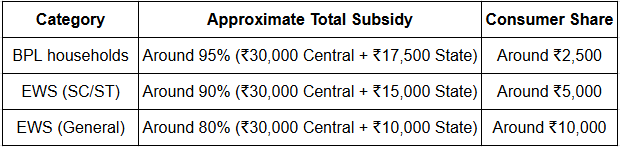
Quick Tip: These figures are for a standard 1kW system size typically associated with the scheme’s lower-consumption target group. If your household’s needs differ, a proper consumption assessment will clarify what system size and subsidy structure actually applies to you.
Because this is a state-backed scheme with a defined budget, it’s been allocated with a total fund of ₹655 crore, applications are generally processed on a first-come, first-served basis – meaning eligible households are generally better off applying sooner rather than waiting.
What if You Don’t Qualify for SMART?
If your household doesn’t meet SMART’s specific consumption or income criteria, you’re not without options – the broader solar rooftop yojana maharashtra framework, under the national rooftop solar program, remains available to most residential consumers.
Key differences to understand:

Quick Tip: Even without SMART eligibility, most homeowners still see meaningful savings under the standard rooftop solar subsidy in Maharashtra – the percentage may be lower, but the long-term bill reduction remains a strong financial case for most households.
How to Apply If You’re Eligible
The application process for SMART generally follows this sequence:
- Register on the applicable portal with your electricity connection and category details
- Submit documentation proving income category (BPL/SC/ST/EWS) and consumption history
- Choose an empanelled installer registered under proper solar panel licensing norms
- Site assessment conducted to confirm technical feasibility
- Installation carried out by the approved vendor
- Inspection by MSEDCL to verify installation quality
- Subsidy disbursement, processed after inspection is complete
Did You Know? After installation, suppliers are typically responsible for maintenance and repairs for five years under the scheme – a detail worth confirming with your specific installer, since this adds valuable long-term protection for eligible households.
Real-World Example: Understanding the Practical Impact
Consider a BPL household in Maharashtra with monthly electricity consumption well under 100 units – a common profile for smaller homes with minimal appliance use. Under SMART, this household could see a substantial majority of their 1kW system’s installation cost covered through combined central and state subsidy, bringing their out-of-pocket contribution down to a relatively small, manageable amount.
Compare this to a household with higher consumption – say, 250-300 units per month – which wouldn’t qualify for SMART specifically, but could still pursue a 2-3kW system under the standard central subsidy scheme, seeing meaningful, though proportionally lower, subsidy support.
Both paths lead to genuine savings – the right one simply depends on your household’s specific consumption and income profile.
Common Mistakes People Make When Evaluating Eligibility
- Assuming SMART is the only subsidy scheme available, and giving up on solar entirely if they don’t qualify for it specifically.
- Not checking actual monthly consumption in units, relying instead on rough guesses about their electricity usage.
- Confusing SMART with the standard central government solar subsidy, leading to incorrect expectations about subsidy percentage.
- Delaying application, given the scheme’s limited, first-come-first-served budget allocation.
- Choosing a non-empanelled installer, which can jeopardize subsidy eligibility under either scheme.
- Not confirming documentation requirements upfront, causing avoidable delays during application review.
Checklist: Before You Apply
- Have you checked your actual average monthly electricity consumption in units, not rupees?
- Do you have documentation confirming your income category (BPL/SC/ST/EWS), if applicable?
- Is your electricity connection registered as residential under MSEDCL?
- Have you confirmed your chosen installer’s current empanelment status?
- Do you understand which scheme – SMART or standard subsidy – actually applies to your household?
- Have you gathered your recent electricity bills as supporting documentation?
ROI Insight: Why Eligibility Clarity Matters for Your Savings
Understanding exactly which scheme applies to your household – SMART or the standard Maharashtra government solar subsidy – directly affects your expected upfront cost and payback timeline. Applying under the wrong assumption, or missing out on SMART eligibility you actually qualify for, means either an incorrect cost expectation or genuinely leaving available subsidy on the table.
Quick Tip: If you’re unsure which category you fall into, it’s worth getting a proper eligibility check before finalizing your system size or budget – the difference between an 80-95% subsidy and a lower standard subsidy percentage significantly changes your investment calculation.
When Should You Contact a Solar Expert?
Reach out to a solar consultant if:
- You’re unsure whether your household qualifies for the SMART scheme specifically.
- Your consumption is close to the 100-unit threshold and you want clarity before applying.
- You want to understand the standard subsidy alternative if SMART doesn’t apply to you.
- You’re ready to apply and want help with documentation and installer selection.
- You want a realistic savings estimate based on your actual electricity bill and category.
A short conversation can help you understand exactly which scheme fits your situation, and avoid applying under incorrect assumptions.
FAQs
1. What is the Maharashtra Smart Solar Scheme? It’s a state-backed rooftop solar subsidy program, officially called the Swayampurna Maharashtra Residential Rooftop (SMART) Solar Scheme, run by MSEDCL and designed to provide substantial subsidy support to low-income, low-consumption residential households.
2. Who is eligible for the Maharashtra Smart Solar Scheme? Eligibility generally requires an active residential MSEDCL connection, monthly electricity consumption below 100 units, and belonging to the BPL, SC, ST, or EWS income category.
3. How much subsidy can I get under the SMART scheme? Depending on your specific category, combined central and state subsidy can range from around 80% to 95% of the installation cost, with BPL households typically receiving the highest percentage.
4. What if my electricity consumption is above 100 units per month? You likely wouldn’t qualify for the SMART scheme specifically, but you can still apply under the standard central government solar subsidy through the national rooftop solar program, which doesn’t have this specific consumption cap.
5. Is the SMART scheme available for commercial properties? No, it’s specifically designed for residential consumers, particularly targeting lower-income households, and isn’t applicable to commercial or industrial properties.
6. How do I apply for the Maharashtra Smart Solar Scheme? The process typically involves registering on the applicable portal, submitting income category and consumption documentation, choosing an empanelled installer, and completing site assessment, installation, and inspection steps before subsidy disbursement.
7. Does the SMART scheme include maintenance support after installation? Many implementations of the scheme include installer-provided maintenance support for a set period after installation – it’s worth confirming these specific terms with your chosen installer.
8. Is there a deadline to apply for the SMART scheme? Since the scheme operates on a defined budget allocation processed on a first-come-first-served basis, eligible households are generally advised to apply sooner rather than later to secure available funds.
Conclusion
The Maharashtra Smart Solar Scheme offers genuinely substantial subsidy support, but it’s specifically targeted at low-income, low-consumption residential households – not a universal program available to every homeowner. If your household fits this profile, it’s one of the most generous rooftop solar subsidy structures currently available. If it doesn’t, the standard central and state subsidy framework still offers meaningful savings for most residential consumers.
The most important first step is simply understanding which category your household actually falls into, so you can apply under the right scheme and set accurate expectations for your savings.
Ready to Find Out Which Scheme You Qualify For?
S’unlimited Solar helps homeowners across Maharashtra determine their exact eligibility – whether under the SMART scheme or standard rooftop solar subsidy – based on their actual consumption and category.
Request your free eligibility check and consultation today →
Get complete clarity on your subsidy options and next steps – with zero obligation.

Pournima
A content writer at S'unlimited with expertise in solar energy education, producing guides and insights that simplify complex industry concepts for homeowners and businesses.