
Solar ROI for Commercial Buildings: How Long Until Panels Pay for Themselves?
Solar ROI for Commercial Buildings: Payback Time Explained
If you’re running a business, a factory, a warehouse, or managing a commercial property, chances are your electricity bill is one of your biggest recurring expenses. And if you’ve been researching solar panels for commercial buildings, you’ve probably asked yourself the same question every serious buyer asks: how long until this actually pays for itself?
It’s a fair question. Solar is a significant upfront investment, and you deserve a straight answer, not vague sales talk. The good news: most commercial solar installations in India pay for themselves in 3 to 6 years, and then go on to generate free electricity for another 15-20 years.
Let’s break down exactly how that math works, what affects your specific payback period, and how to make sure your solar investment performs the way it should.
Quick Answer: What’s the Average ROI Timeline?
For businesses exploring commercial rooftop solar installation, here’s the short version:
- Typical payback period: 3 to 6 years
- System lifespan: 25+ years
- Net savings after payback: 15-20+ years of near-free power
- Typical ROI: 18-25% annually once payback is complete
That means a solar system installed today could still be saving you money in 2046 and beyond – long after it’s paid for itself several times over.
Did You Know? Commercial and industrial electricity tariffs are usually higher than residential rates. That means businesses often see a faster solar payback than homeowners, simply because they’re saving more per unit of power generated.
What Determines Your Solar Payback Period?
No two businesses have identical ROI timelines. Here’s what actually moves the needle.
1. Your Current Electricity Consumption & Tariff
The higher your current bill, the faster solar pays back. A factory running high-load machinery through the day sees quicker returns than an office that’s mostly empty on weekends.
Ask yourself: What’s your average monthly electricity bill right now? If it’s consistently above ₹20,000-₹25,000, solar is very likely a strong financial move for you.
2. System Size & Load Matching
An oversized system wastes capital; an undersized one leaves savings on the table. Proper industrial solar panel installation starts with a detailed load audit – matching panel capacity to your actual daytime consumption pattern.
3. Roof Type, Space & Orientation
Flat industrial roofs, RCC rooftops, and metal sheds all have different mounting requirements and costs. Shadow-free south-facing space maximizes generation and shortens payback.
4. Available Subsidies & Incentives
Government incentives, accelerated depreciation benefits (for businesses), and net metering policies can significantly cut your effective cost and shrink payback time.
5. Quality of Components & Installation
This one’s often overlooked. Cheap panels and inverters degrade faster, generate less, and increase maintenance costs – quietly stretching your payback period by years. This is where commercial solar energy solutions from an experienced installer really matter.
Real-World ROI Example
Let’s look at a simplified example for a mid-sized manufacturing unit:
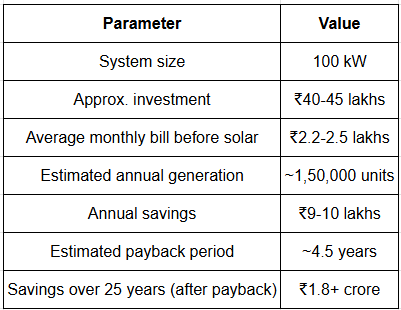
Note: These figures are illustrative. Your actual numbers depend on location, tariff structure, roof condition, and system design – which is exactly why a proper site survey matters before you commit.
Commercial vs Industrial Solar: Does the Payback Differ?
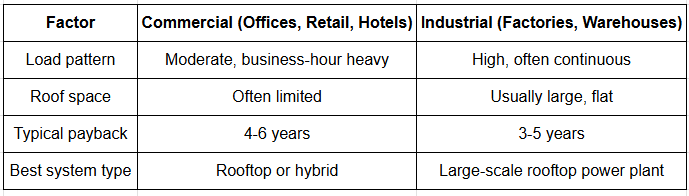
Whether you need a commercial rooftop solar solution for an office complex or a full industrial rooftop solar power plant for a manufacturing facility, the underlying ROI principles stay the same – it’s the scale and load pattern that shift the numbers.
Common Mistakes That Delay Solar ROI
Avoid these, and you’ll protect (or improve) your payback timeline:
- Undersizing the system to save on upfront cost – leaves savings on the table for 25 years
- Skipping a proper site survey and shadow analysis
- Choosing the cheapest quote without checking panel/inverter quality or warranties
- Ignoring net metering paperwork, which delays when you start earning credits
- Not maintaining panels – dust and debris buildup can silently cut generation by 10-15%
- Not accounting for future load growth if your business is expanding
Quick Tip: Ask any installer for their actual generation data from a similar existing installation, not just projected numbers on paper. Real performance data tells you far more than a sales brochure.
Decision-Making Checklist: Is Solar Right for Your Building Right Now?
Before you request a quote, run through this:
- Is your average monthly electricity bill above ₹15,000-₹20,000?
- Do you have unshaded roof or ground space available?
- Do you plan to stay in/own this property for at least 5+ years?
- Is your daytime power consumption significant (offices, factories, cold storage, etc.)?
- Are you open to financing or looking to pay upfront for faster ROI?
If you checked 3 or more boxes, it’s worth getting a professional site assessment.
How to Speed Up Your Solar ROI
- Right-size the system based on actual consumption data, not guesswork
- Choose high-efficiency panels with strong performance warranties
- Apply for applicable subsidies and depreciation benefits where eligible
- Opt for net metering so unused daytime generation earns bill credits
- Schedule regular maintenance – even quarterly panel cleaning helps
- Monitor performance with a monitoring system to catch underperformance early
When Should You Contact a Solar Expert?
You don’t need to have all the answers before reaching out – that’s what a consultation is for. But it’s especially worth talking to a commercial solar energy solutions provider if:
- You’re planning a new construction or major renovation
- Your electricity bills have been rising steadily
- You’re expanding operations and expect higher future load
- You’ve received conflicting quotes and need a second opinion
- You want to understand financing or subsidy eligibility
At this stage, a proper site survey (roof assessment, load study, shadow analysis, and a customized ROI report) will give you numbers you can actually plan around – not rough estimates.
FAQs: Solar ROI for Commercial Buildings
1. How long does it take for commercial solar panels to pay for themselves? Most commercial installations pay back their investment in 3 to 6 years, depending on system size, electricity tariffs, and consumption patterns. After that, the system generates 15-20+ years of largely free electricity.
2. What is a good ROI for commercial solar panels? Once payback is complete, businesses typically see an annual ROI of 18-25% for the remaining life of the system, since ongoing maintenance costs are minimal compared to electricity savings.
3. Do industrial solar installations pay back faster than commercial ones? Generally, yes. Industrial facilities often have higher, more consistent daytime power consumption, which means more of the solar generation is used directly rather than exported – leading to faster payback in many cases.
4. Does roof type affect solar ROI? Yes. Flat RCC roofs and metal industrial sheds have different mounting costs and structural considerations. A site survey determines the most cost-effective mounting solution for your specific roof.
5. Can net metering improve my payback period? Yes. Net metering allows excess daytime generation to be credited against your consumption, effectively letting you “bank” solar power and reducing your net bill further, which shortens payback.
6. What maintenance is needed to protect my ROI? Routine panel cleaning, periodic inverter checks, and generation monitoring are usually sufficient. Neglecting maintenance can quietly reduce output and stretch your payback timeline.
7. Is financing available for commercial solar installations? Yes, many providers offer financing options alongside applicable subsidies and depreciation benefits for businesses, which can reduce upfront costs and improve effective ROI.
8. How do I get an accurate ROI estimate for my building? The only reliable way is a professional site survey that looks at your roof, shading, current consumption, and local tariff structure. Generic online calculators give rough estimates at best.
Conclusion
Solar isn’t just an environmental decision anymore – for commercial and industrial property owners, it’s a financial one. With payback periods as short as 3-6 years and system lifespans well beyond 25 years, solar panels for commercial buildings are one of the few investments that keep paying you back long after you’ve stopped thinking about them.
The real question isn’t whether solar makes financial sense for most businesses – it usually does. The question is: what does the ROI look like for your specific building, roof, and electricity usage?
That’s not something a blog post (or a generic calculator) can answer precisely. It takes a real site visit and real numbers.
Get Your Free Solar ROI Estimate
S’unlimited Solar has helped commercial and industrial property owners across sectors switch to solar with installations designed around real consumption data – not guesswork. From commercial rooftop solar installation for offices and retail spaces to full-scale industrial rooftop solar power plants for manufacturing units, our team handles everything from site survey to subsidy paperwork to installation and maintenance.
Ready to see your actual payback numbers?
Request a Free Site Survey & Custom ROI Report →
No pressure, no obligation – just clear numbers so you can make an informed decision.

Pournima
A content writer at S'unlimited with expertise in solar energy education, producing guides and insights that simplify complex industry concepts for homeowners and businesses.