
What Is the Maharashtra Smart Solar Scheme? A Simple Guide for Homeowners
Maharashtra Smart Solar Scheme: A Homeowner’s Guide
If you’ve been staring at your electricity bill wondering whether solar is finally worth it, you’re not alone – and the timing couldn’t be better. The Maharashtra smart solar scheme is one of the most generous rooftop solar subsidy programs the state has ever rolled out, and it’s changing how homeowners, and in many cases businesses, think about going solar.
But if you’ve tried researching it online, you’ve probably run into a mess of conflicting numbers, confusing eligibility rules, and government portals that don’t explain much in plain language. This guide clears all of that up. By the end, you’ll know exactly what the scheme is, who qualifies, how much you can actually save, and what steps to take next.
What Is the Maharashtra Smart Solar Scheme, Exactly?
The Maharashtra Smart Solar Scheme – officially the Swayampurna Maharashtra Residential Rooftop (SMART) Solar Scheme – is a state government initiative implemented by MSEDCL (Maharashtra State Electricity Distribution Company Limited). It’s designed to make rooftop solar affordable for residential consumers, particularly households with lower monthly electricity usage.
The scheme works alongside the central government’s PM Surya Ghar Muft Bijli Yojana, combining state and central funding into one government solar subsidy package. In simple terms: the government pays a large chunk of your solar installation cost, and you pay the rest – sometimes as little as 5-10% of the total price.
Quick Tip: Even if you don’t fall into the scheme’s specific low-consumption category, you’re very likely still eligible for solar subsidies under the broader central government solar subsidy scheme (PM Surya Ghar Muft Bijli Yojana). Don’t assume you’re excluded – get your eligibility checked first.
Why Was This Scheme Introduced?
Maharashtra is one of India’s largest electricity-consuming states, and rooftop solar has been identified as one of the fastest ways to:
- Reduce pressure on the state power grid
- Lower household electricity bills, sometimes to nearly zero
- Help India move toward its renewable energy targets
- Give households a way to earn by selling surplus power back to the grid
For homeowners, businesses, and commercial property owners alike, this translates into one thing that matters most: lower long-term energy costs with government money doing the heavy lifting upfront.
Ask yourself: What’s your average monthly electricity bill right now? If it’s consistently above ₹2,000–₹3,000, solar – with or without the low-income scheme tier – is very likely to pay for itself faster than you think.
Who Is Eligible for the Maharashtra Smart Solar Scheme?
This is where most of the confusion online comes from, so let’s break it down clearly.
The SMART Solar Scheme’s highest subsidy tiers (up to 90-95%) specifically target:
- Households consuming less than 100 units of electricity per month
- Families classified as Below Poverty Line (BPL)
- Economically Weaker Section (EWS) consumers
- Scheduled Caste (SC) and Scheduled Tribe (ST) households
If you fall into one of these categories, your out-of-pocket cost for a 1kW rooftop system can be as low as ₹5,000–₹10,000, with the rest covered by combined state and central funding.
But here’s what most articles won’t tell you clearly: if you don’t fall into these categories, you’re not out of options. Most Maharashtra homeowners and businesses still qualify for the standard central government solar subsidy under PM Surya Ghar Muft Bijli Yojana, which offers substantial support (currently capped around ₹78,000 for eligible residential systems) regardless of income category – just at a different subsidy percentage.
Quick Eligibility Checklist
Before you get your hopes up (or dismiss the idea entirely), check:
- Do you own the property, or have documented permission to install solar on the roof?
- Is your monthly electricity consumption under 100 units? (Higher usage still qualifies for standard subsidy tiers)
- Do you have a valid electricity connection in your name?
- Is your roof suitable for solar (space, structure, shading)?
- Do you have the required documents ready (ID proof, electricity bill, property proof)?
If you’ve checked most of these boxes, you’re in a strong position to apply. If you’re unsure about any of them – particularly roof suitability – that’s exactly where a quick site survey from a solar expert saves you weeks of guesswork.
How Much Can You Actually Save? (Solar Subsidy in Maharashtra Explained)
Here’s a simplified breakdown of how the solar subsidy in Maharashtra works across categories:
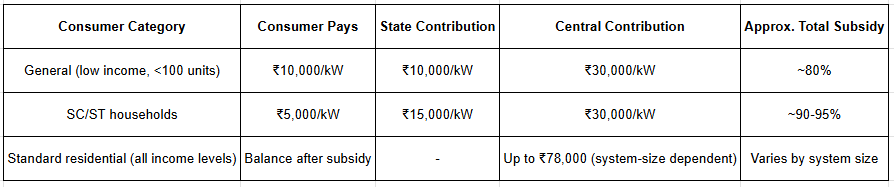
Real-world example: A household using under 100 units a month installs a 1kW system, which typically generates around 120 units monthly. That’s often enough to bring their electricity bill down to zero – and in months with lower usage, they can even earn credit by exporting surplus power back to the grid through net metering.
Did You Know? Net metering is mandatory for all subsidy-eligible grid-connected solar systems in Maharashtra. This means any extra power your panels generate doesn’t go to waste – it gets credited back to your account.
For most homeowners outside the lowest-income brackets, ROI (return on investment) on a well-sized rooftop solar system typically ranges from 4 to 6 years, after which the electricity generated is essentially free for the remaining 20+ years of the system’s life.
Common Mistakes Homeowners Make When Applying
Even with a generous subsidy on the table, plenty of applicants run into avoidable delays. Watch out for these:
- Choosing non-BIS/ALMM-certified panels. Only approved, certified panels and inverters qualify for subsidy – using the wrong vendor or product can get your application rejected.
- Incomplete or mismatched documentation. Names, addresses, and consumer numbers must match exactly across your electricity bill, ID proof, and application.
- Underestimating or overestimating system size. Too small, and you won’t cover your usage; too large, and you may not maximize subsidy efficiency.
- Applying without a roof assessment. Shading, roof angle, and structural load all affect performance – skipping this step leads to underperforming systems.
- Assuming the scheme applies to commercial or industrial properties. The SMART scheme’s highest subsidy tiers are residential-focused. Businesses and industries have separate solar subsidy pathways worth exploring – more on that below.
- Missing the funding window. These schemes operate on allocated state budgets. Applying early matters – funds are limited and processed on a first-come, eligible-first-served basis.
Quick Tip: Getting professional help with your application and documentation isn’t just about convenience – it directly affects your approval speed and reduces the risk of rejection.
What About Businesses, Industries, and Commercial Properties?
If you’re a business owner or manage a commercial or industrial property, the SMART Solar Scheme’s residential subsidy tiers won’t directly apply to you – but that doesn’t mean solar isn’t worth it. In fact, commercial and industrial solar installations often deliver even stronger ROI, because:
- Businesses typically consume more electricity, meaning bigger absolute savings
- Commercial solar can be paired with accelerated depreciation benefits
- Larger rooftop or ground-mounted systems benefit from economies of scale
- Reduced operating costs directly improve profit margins
Separate central and state-level incentive structures exist for commercial and industrial solar adoption, and navigating solar panel licensing, approvals, and net metering agreements for larger systems involves more regulatory steps than a residential install.
This is exactly where the process gets complicated for most property owners – and exactly where expert guidance makes the biggest difference.
Understanding Solar Panel Licensing and Government Procedures
One of the most overlooked parts of going solar – whether residential or commercial – is the licensing and approval process. This includes:
- Registering on the official solar subsidy portal
- Getting your application verified by MSEDCL
- Coordinating a technical site inspection
- Ensuring your installer uses ALMM-listed, subsidy-approved equipment
- Completing net metering registration
- Receiving final approval and subsidy disbursement (which typically takes 30-90 days post-installation)
This is often the most frustrating part of the entire journey – not because solar itself is complicated, but because government procedures involve multiple approvals, inspections, and paperwork checkpoints that are easy to get wrong if you’re doing it for the first time.
When Should You Contact a Solar Expert?
You don’t need to wait until you’ve figured everything out on your own. It genuinely makes sense to reach out to a solar consultant when:
- You’re unsure whether you qualify for the SMART scheme or the standard central subsidy
- You want an accurate estimate of system size, cost, and savings for your specific property
- You’ve started the application process and hit a documentation or eligibility snag
- You’re a business or commercial property owner exploring solar for the first time
- You want to avoid costly mistakes with panel selection, licensing, or net metering setup
- You simply want someone to handle the entire process – survey to installation to subsidy approval – so you don’t have to
Frequently Asked Questions
What is the Maharashtra Smart Solar Scheme? It’s a state government initiative (SMART Solar Scheme) that provides heavily subsidized rooftop solar installations, primarily for low-income and economically weaker households, funded jointly by the Maharashtra state government and the central government under PM Surya Ghar Muft Bijli Yojana.
Who is eligible for the highest subsidy under this scheme? Households consuming less than 100 units of electricity per month, along with BPL, EWS, SC, and ST category consumers, are eligible for subsidies ranging from 80% to 95% of installation cost.
Can homeowners with higher electricity consumption still get a solar subsidy in Maharashtra? Yes. Even if you don’t qualify for the SMART scheme’s highest tier, most homeowners are still eligible for the standard central government solar subsidy under PM Surya Ghar Muft Bijli Yojana.
Is the solar subsidy available for commercial or industrial properties? The SMART scheme’s residential subsidy tiers are not available for commercial or industrial properties, but separate incentive structures and financial benefits exist for businesses considering solar.
How long does it take to get subsidy approval after installation? Typically between 30 to 90 days, depending on document verification, site inspection scheduling, and application volume.
What documents do I need to apply for the rooftop solar subsidy in Maharashtra? Generally, you’ll need proof of identity, a recent electricity bill, proof of property ownership or authorization, and your consumer account details. Requirements can vary slightly depending on your category.
Is net metering mandatory under the Maharashtra solar rooftop yojana? Yes, net metering is mandatory for all subsidy-eligible grid-connected residential solar systems, allowing you to earn credit for surplus power sent back to the grid.
How much can I actually save with the Maharashtra government solar subsidy? Savings depend on your system size and consumption, but many eligible households see their electricity bills drop to near zero, with typical ROI achieved within 4 to 6 years for standard residential systems, and even faster for those in the highest subsidy tiers.
Conclusion: Is the Maharashtra Smart Solar Scheme Worth It?
For the vast majority of homeowners in Maharashtra, the answer is a clear yes. Whether you qualify for the highest subsidy tier under the Maharashtra smart solar scheme or fall under the standard government solar scheme for home installations, the combination of reduced upfront costs, lower monthly bills, and a genuinely fast payback period makes rooftop solar one of the smartest financial decisions a property owner can make right now.
The real challenge isn’t whether solar is worth it – it’s navigating the eligibility rules, documentation, and licensing procedures correctly the first time, without losing weeks to rejected applications or missed subsidy windows.
That’s exactly the gap S’unlimited Solar exists to close.
Ready to Find Out What You Qualify For?
You don’t need to figure out the Maharashtra smart solar scheme, subsidy tiers, or licensing procedures on your own. S’unlimited Solar helps homeowners, businesses, and industrial property owners across Maharashtra:
Check eligibility for the SMART scheme and central government solar subsidy | Get an accurate, no-obligation site survey and system estimate | Handle documentation and government licensing procedures correctly | Install high-quality, certified solar systems built for maximum ROI
Request your free consultation and site survey today →
Stop guessing whether you qualify – let our team give you a clear answer, a clear savings estimate, and a clear path to going solar the right way.

Pournima
A content writer at S'unlimited with expertise in solar energy education, producing guides and insights that simplify complex industry concepts for homeowners and businesses.