
Bringing Solar to Satara: What Local Homeowners Should Know Before Installing
Solar Installation Company in Satara
Solar adoption has been steadily growing across Maharashtra, and Satara is no exception. More homeowners here are looking into rooftop solar – not just as a trend, but as a genuinely practical response to rising electricity bills. If you’re considering it too, choosing the right solar installation company in Satara is where the entire experience either goes smoothly or gets complicated.
Satara has its own mix of housing types, weather patterns, and local DISCOM processes – all of which affect how a solar installation should actually be planned. What works well for a home in a big metro city doesn’t always translate directly to a Satara rooftop.
This blog walks through exactly what local homeowners should understand before installing solar – from evaluating your own home’s suitability to choosing an installer who genuinely understands the region.
Quick Answer: What Should Satara Homeowners Know Before Installing Solar?
Before installing solar in Satara, homeowners should understand:
- Whether their roof orientation and shading suit solar generation in this specific region
- How local weather patterns – including monsoon intensity – affect system design
- The importance of choosing an empanelled solar company in Satara for subsidy eligibility
- Realistic cost, savings, and payback expectations based on typical Satara electricity bills
- What to check before signing any installation contract
Quick Tip: A solar installer familiar with Satara specifically – its DISCOM processing patterns, common roof types, and local weather – often navigates the process more smoothly than one applying a generic, one-size-fits-all approach.
Why More Satara Homeowners Are Considering Solar
A few practical factors are driving this shift locally.
- Rising electricity tariffs make solar’s long-term savings increasingly noticeable compared to a few years ago.
- Good sunlight availability across most of the year makes Satara reasonably well-suited for residential solar generation.
- Growing awareness of government subsidy schemes, making the upfront investment more accessible than many homeowners initially assume.
- Word-of-mouth from early adopters in the community, as more homes complete installations and share their actual experience.
Did You Know? Homes with south-facing or largely unobstructed rooftops typically see the most consistent solar generation throughout the year – a detail worth checking before assuming your specific roof will perform identically to a neighbor’s installation.
Ask yourself: What’s your average monthly electricity bill? If it consistently runs above ₹2,000-2,500, solar is generally worth seriously evaluating for your home.
Step 1: Assess Whether Your Roof Is Actually Suitable
Before contacting any installer, it helps to have a basic understanding of what makes a rooftop genuinely suitable for solar.
Key things to check:
- Orientation – south-facing roofs generally receive the most consistent sunlight
- Shading – trees, neighboring buildings, or water tanks can significantly reduce output if not accounted for
- Roof material and condition – RCC roofs are generally straightforward for mounting, while older or weaker structures may need reinforcement
- Available space – enough clear area for your target system size, accounting for obstructions
Quick Tip: A proper solar installation company will conduct a physical site visit and shading analysis before quoting – not just estimate based on a phone conversation about your roof size.
Step 2: Understand How Local Weather Affects Your System
Satara experiences a mix of strong summer sun and a fairly active monsoon season – both of which should factor into how your system is designed.
What to discuss with your installer:
- Mounting structure durability suited to monsoon wind and rain conditions
- Expected seasonal variation in generation between summer and monsoon months
- Proper earthing and lightning protection, particularly relevant given regional weather patterns
Did You Know? A well-designed system accounts for expected seasonal dips during monsoon months as part of normal annual generation planning – this isn’t a sign of a problem, but a predictable pattern that a good installer should explain upfront.
Step 3: Choose an Empanelled, Locally Experienced Installer
This is arguably the most important decision in the entire process.
Why empanelment matters:
- Only empanelled installers can offer systems eligible for government solar subsidy.
- A solar energy company in Satara that isn’t currently empanelled means your subsidy application won’t go through, regardless of installation quality.
Why local experience matters:
- Familiarity with Satara’s specific DISCOM processing patterns and typical approval timelines
- Understanding of common local roof types and how to handle them
- Faster response for after-sales service, given physical proximity
Quick Tip: Ask any installer directly: “How many installations have you completed specifically in Satara?” A confident, specific answer is a good sign; vague responses are worth probing further.
Step 4: Get a Transparent, Itemized Quote
A trustworthy quote should never be a single lump-sum number.
Your quote should clearly show:
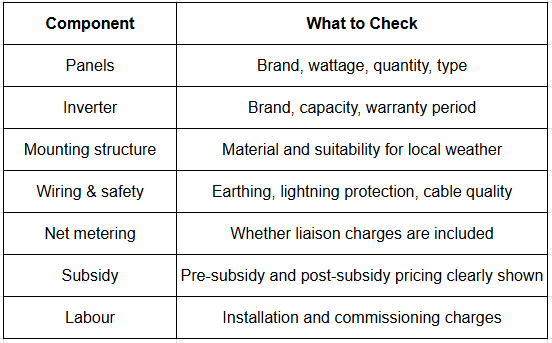
Quick Tip: If two quotes show similar totals but one is itemized and one isn’t, always request a full breakdown from the non-itemized quote before comparing – a single number tells you very little about actual value.
Step 5: Understand Realistic Costs and Payback for Satara Homes
While exact costs vary based on system size, brand, and roof conditions, here’s a general sense of what residential solar typically looks like for Satara homes:

Real-world example: A homeowner in Satara with a monthly electricity bill of around ₹2,800 installs a 3kW system. After subsidy is applied, their effective installation cost drops meaningfully, with payback typically achieved within roughly 4-6 years, followed by many more years of significantly reduced electricity bills.
Common Mistakes Satara Homeowners Make When Going Solar
- Not verifying empanelment status, risking subsidy rejection after installation is complete.
- Choosing an installer purely based on the lowest quote, without checking what’s actually included.
- Skipping proper shading analysis, assuming a rooftop is “clear enough” without professional assessment.
- Not asking about after-sales support, assuming the relationship ends once installation is done.
- Underestimating monsoon-related design considerations, leading to less durable mounting choices.
- Comparing quotes without separating pre-subsidy and post-subsidy pricing.
Checklist: Before You Install Solar in Satara
- Has your roof been properly assessed for orientation, shading, and structural suitability?
- Has the installer explained how your system is designed around local weather conditions?
- Is the installer currently empanelled, with proof provided?
- Do they have specific, verifiable experience with installations in Satara?
- Is your quote itemized, showing pre-subsidy and post-subsidy pricing separately?
- Are warranty terms for panels, inverter, and workmanship specified in writing?
- Does the installer offer after-sales support or monitoring?
ROI Insight: Why Getting These Details Right Protects Your Savings
Every step outlined above – proper roof assessment, weather-conscious design, empanelment verification, transparent pricing – directly protects the actual savings calculation that makes solar worthwhile in the first place. Skipping any of these steps risks either losing subsidy eligibility, dealing with a poorly performing system, or facing unexpected costs down the line.
Quick Tip: A slightly higher quote from a properly empanelled, locally experienced installer often delivers significantly better long-term value than the cheapest option with vague terms and no verifiable local track record.
When Should You Contact a Solar Expert?
Reach out to a solar consultant if:
- You’re unsure whether your specific roof is well-suited for solar.
- You want to understand realistic savings based on your actual electricity bill.
- You’re comparing multiple quotes and unsure how to evaluate them fairly.
- You want to verify an installer’s empanelment status before signing anything.
- You simply want a clear, honest walkthrough of the process before committing.
A short conversation with a local expert can help you avoid common pitfalls and move forward with confidence.
FAQs
1. Is solar a good investment for homes in Satara? Yes, for most homeowners with moderate to high electricity bills, solar typically delivers meaningful long-term savings, especially when combined with available government subsidy.
2. How do I find a reliable solar installation company in Satara? Look for current empanelment status, transparent itemized quotes, verifiable local installation experience, and clear warranty terms before choosing an installer.
3. Does Satara’s weather affect solar panel performance? Yes, generation naturally varies between strong summer sunlight and reduced output during monsoon season, though a properly designed system accounts for this as part of normal annual planning.
4. What size solar system is right for an average home in Satara? This depends on your electricity consumption, but many average households find a 2-3 kW system offers a good balance of subsidy benefit and bill offset – a proper site assessment can confirm the ideal size for your specific home.
5. Can I get government subsidy for solar installation in Satara? Yes, as long as your installation is carried out by a currently empanelled installer and you meet standard residential eligibility criteria under the applicable subsidy scheme.
6. How long does solar installation typically take for a home in Satara? Physical installation for a typical residential system usually takes a few days, though the complete process including inspection and net metering approval can take several weeks.
7. What should I check before signing a contract with a solar energy company in Satara? Verify empanelment status, request an itemized quote, get warranty terms in writing, and ask about after-sales support before signing anything.
8. Does monsoon season affect solar panel maintenance in Satara? Yes, monsoon conditions make sturdy mounting structures and proper earthing especially important, and post-monsoon inspection is generally a good practice to check for any wear.
Conclusion
Bringing solar to your home in Satara is a genuinely worthwhile investment for most homeowners – but getting the details right upfront makes all the difference. From assessing your roof’s suitability and understanding local weather considerations, to verifying empanelment and getting a transparent quote, each step protects both your subsidy eligibility and your long-term savings.
Choosing a solar installation company in Satara that understands the local context – not just a generic, one-size-fits-all approach – is what turns a solar investment into a genuinely smooth, rewarding experience.
Ready to Bring Solar to Your Satara Home?
S’unlimited Solar combines local expertise with transparent pricing, verified empanelment, and dependable after-sales support for homeowners across Satara.
Request your free consultation and site survey today →
Get complete clarity before you decide – with zero obligation.

Pournima
A content writer at S'unlimited with expertise in solar energy education, producing guides and insights that simplify complex industry concepts for homeowners and businesses.