
Real-Time vs App-Based Solar Monitoring: Which Solution Fits Your Home?
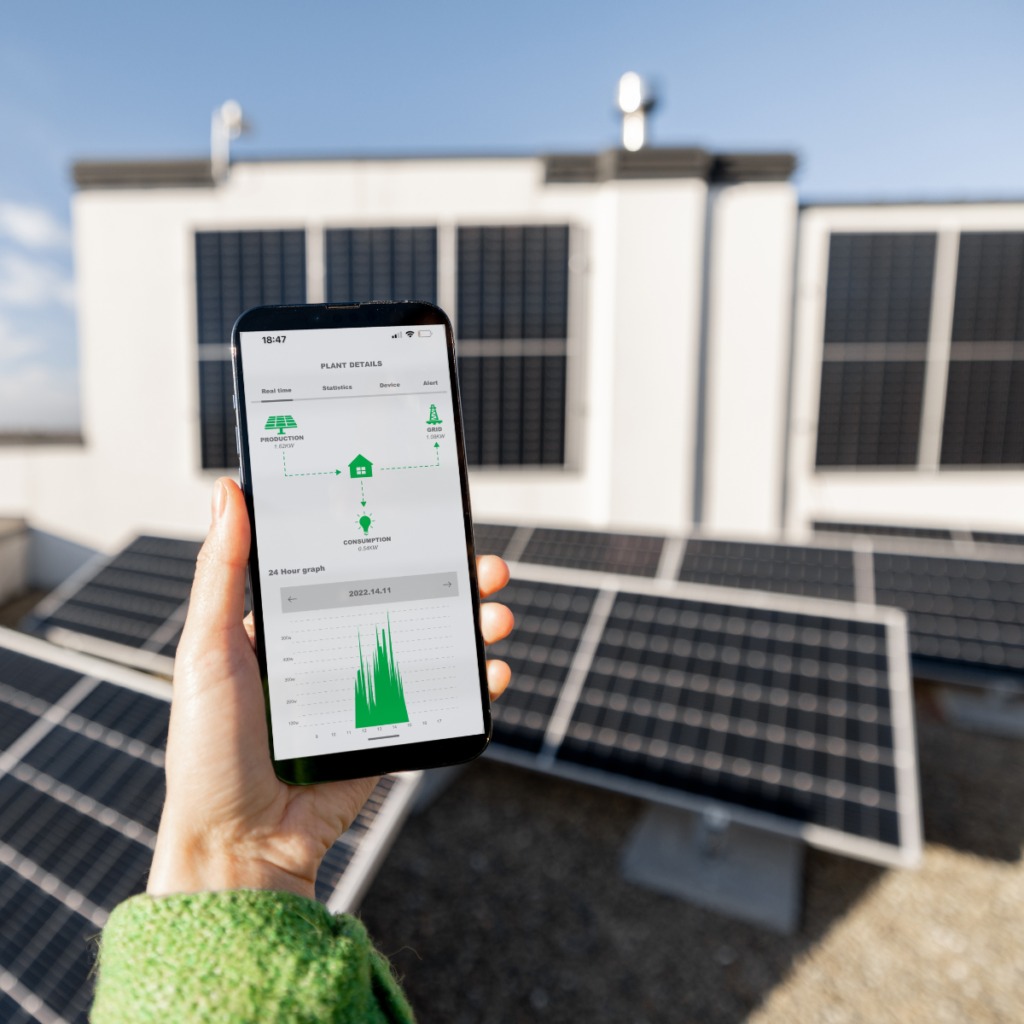
Solar Monitoring Solutions: Real-Time vs App-Based
Once you start comparing solar monitoring solutions, you’ll notice most of them fall into one of two camps: systems that track and alert continuously in real time, and simpler app-based setups that show periodic summaries you check yourself. On paper, both sound like they do the same job – tell you how your solar system is performing. In practice, they work quite differently, and choosing the wrong one for your situation can mean missing problems that quietly cost you money.
This isn’t a case of one option being universally “better.” A small home system with straightforward consumption might do just fine with app-based summaries, while a larger residential setup, or one where you want genuine peace of mind, often benefits significantly from real-time tracking.
In this blog, we’ll break down exactly how these two approaches differ, what each one is actually good for, and how to figure out which fits your home.
Quick Answer: Real-Time vs App-Based Monitoring – What’s the Difference?
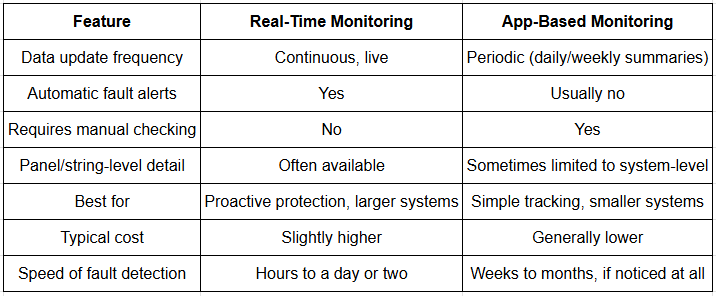
- Real-time monitoring continuously tracks your system’s performance and automatically alerts you the moment something deviates from expected output – no manual checking required.
- App-based monitoring typically shows periodic data (daily, weekly, or monthly summaries) that you actively check yourself, without automatic anomaly detection.
Quick Tip: If you tend to forget to check apps regularly, real-time alert-based monitoring protects you far more effectively – since the system, not your memory, is responsible for catching issues.
Understanding Real-Time Solar Monitoring
Real-time monitoring continuously compares your system’s actual output against expected generation, flagging deviations as they happen.
What it typically includes:
- Live power output readings (kW), updated continuously
- Automatic fault detection and alerts sent via SMS, app notification, or email
- Panel or string-level tracking in more advanced setups
- Historical trend comparison alongside live data
Best suited for:
- Homeowners who want proactive protection without manually checking data
- Larger residential systems with more panels/strings to monitor
- Anyone who’s had unnoticed performance issues in the past
Did You Know? A good real-time solar power monitoring system is designed to distinguish normal weather-related fluctuation (like a cloudy afternoon) from a genuine fault – so you’re not bombarded with unnecessary alerts every time the sky changes.
Understanding App-Based Solar Monitoring
App-based monitoring generally refers to systems where you actively open an app to check your system’s performance – daily totals, monthly summaries, historical graphs – without automatic real-time alerting built in.
What it typically includes:
- Daily, weekly, and monthly generation summaries
- Basic historical performance graphs
- Manual comparison against expected output (you do the analysis)
- Simple, easy-to-read dashboards
Best suited for:
- Homeowners with smaller, simpler systems and consistent daily routines
- People who enjoy actively checking and engaging with their system’s performance
- Situations where budget is a primary consideration and basic tracking suffices
Ask yourself: Realistically, how often do you open apps just to check on something unless prompted by a notification? Your honest answer here says a lot about which monitoring style will actually work for you.
Comparison Table: Real-Time vs App-Based Monitoring
Real-World Example: Same Fault, Different Outcomes
Consider two homeowners with similar 4kW rooftop systems, each experiencing a loose panel connector due to gradual thermal wear.
Homeowner A (app-based monitoring): They check the app occasionally, but without automatic alerts, the gradual output decline blends into normal variation. They only notice something’s off after a couple of months, when their electricity bill is noticeably higher than expected.
Homeowner B (real-time monitoring): An automatic alert flags the underperformance within a day or two of it starting. A quick inspection identifies the loose connector, and it’s fixed before significant savings are lost.
Quick Tip: The extra cost of real-time monitoring is often small compared to what even a few months of undetected underperformance can cost – especially for larger or more consumption-heavy homes.
When App-Based Monitoring Is Genuinely Enough
To be fair, real-time monitoring isn’t strictly necessary for every home. App-based tracking can work well when:
- Your system is small (typically 1-3 kW) with straightforward, predictable consumption
- You’re comfortable checking your app regularly as part of your routine
- Your budget prioritizes a lower-cost monitoring option
- You don’t have significant shading complexity or multiple roof sections
Quick Tip: Even with app-based monitoring, make it a habit to compare your monthly generation against the same month last year – this simple manual check catches gradual decline that daily glances often miss.
When Real-Time Monitoring Makes More Sense
Real-time, alert-based solar energy monitoring system setups are generally worth the investment when:
- Your system is larger (5kW+) with more panels or strings to track
- You want peace of mind without needing to actively check an app
- Your roof has partial shading or complex layout, where issues are harder to spot manually
- You’re managing multiple properties or want centralized alerting
- You’ve previously experienced unnoticed performance issues
Common Mistakes People Make When Choosing a Monitoring Solution
- Assuming app-based monitoring automatically includes fault alerts – many basic apps only show data, without proactive notifications.
- Choosing based on app design alone, rather than checking whether real-time alerting is actually included.
- Underestimating how often they’ll realistically check a passive app without built-in reminders.
- Assuming real-time monitoring is only necessary for commercial systems, when larger residential setups benefit significantly too.
- Not asking specifically how quickly a monitoring solution detects and reports faults.
- Ignoring historical trend comparison, even with app-based tools that do offer it.
Checklist: Choosing the Right Monitoring Solution for Your Home
- Is your system size small and straightforward, or larger with more complexity?
- Do you realistically check apps proactively, or only when prompted?
- Does the solution include automatic fault alerts, or just periodic data display?
- Is panel or string-level detail available if your roof has shading challenges?
- Does the provider explain how quickly faults are typically detected?
- Have you compared the cost difference against the potential savings protected?
ROI Insight: Which Option Actually Protects Your Savings Better?
The core financial logic is simple: the faster a fault is detected, the less savings you lose to undetected underperformance. Real-time solar power tracking system setups generally protect ROI more effectively for larger or more complex systems, simply because they remove the dependency on you remembering to check and correctly interpret the data yourself.
For smaller, simpler systems, app-based monitoring combined with a consistent personal habit of checking monthly trends can still deliver reasonable protection – just with a slower detection timeline if something does go wrong.
Quick Tip: When comparing monitoring costs, think in terms of “cost per month” against “potential savings lost per month of undetected fault” – this framing usually makes the value of real-time monitoring much clearer.
When Should You Contact a Solar Expert?
Reach out to a monitoring specialist if:
- You’re unsure whether your current app-based setup includes real fault alerting.
- Your home system is larger or has shading complexity that makes manual tracking difficult.
- You’ve experienced unexplained increases in your electricity bill.
- You want a monitoring solution that requires less active effort from you.
- You’re setting up monitoring for a new installation and want guidance on the right level for your home.
A quick conversation can help you understand exactly what level of monitoring genuinely suits your system size and lifestyle.
FAQs
1. What’s the main difference between real-time and app-based solar monitoring? Real-time monitoring continuously tracks performance and sends automatic alerts when something’s wrong, while app-based monitoring typically shows periodic data that you need to check and interpret yourself.
2. Is real-time monitoring necessary for a small home solar system? Not always. Smaller, simple systems can often be adequately tracked with app-based monitoring, especially if you’re consistent about checking monthly trends yourself.
3. Does app-based solar monitoring include fault alerts? Not necessarily. Many basic app-based solutions only display generation data without proactive fault detection – it’s worth confirming this specifically before choosing a provider.
4. How much faster does real-time monitoring detect problems compared to app-based tracking? Real-time systems typically flag issues within a day or two, while app-based tracking often only reveals problems weeks or months later, if the user notices the pattern themselves.
5. Is real-time solar monitoring more expensive than app-based options? Generally, yes, though the difference is often small compared to the potential savings protected by faster fault detection, especially for larger systems.
6. Can I upgrade from app-based to real-time monitoring later? In many cases, yes, though this depends on your existing system’s hardware compatibility – it’s worth asking your installer about upgrade options if you start with a basic setup.
7. Does real-time monitoring work well for homes with roof shading issues? Yes, real-time and panel/string-level monitoring is particularly useful for homes with shading complexity, since it helps pinpoint exactly which section of the system is affected.
8. What should I ask before choosing a solar energy tracking system for my home? Ask specifically whether the solution includes automatic fault alerts, how quickly it typically detects issues, and whether it offers panel or string-level detail if your roof layout requires it.
Conclusion
Choosing between real-time and app-based solar monitoring solutions ultimately comes down to your system’s size, complexity, and how actively you’re willing to check performance data yourself. Real-time monitoring offers stronger, more proactive protection – especially valuable for larger systems or homeowners who want peace of mind without manual effort. App-based tracking can work well for simpler systems, provided you build a consistent habit of reviewing your data.
Whichever option you choose, the goal remains the same: catching performance issues early enough to protect the savings your solar investment was designed to deliver.
Ready to Find the Right Monitoring Solution for Your Home?
S’unlimited Solar‘s active monitoring solutions offer both real-time alerting and accessible tracking, tailored to your home’s system size and needs.
Get a monitoring setup that actually matches how you want to stay informed – with zero obligation.

Pournima
A content writer at S'unlimited with expertise in solar energy education, producing guides and insights that simplify complex industry concepts for homeowners and businesses.