
Solar O&M Services Explained: What Happens After Your Panels Are Installed
Solar O&M Services: What Happens After Installation
The day your solar panels are switched on feels like the finish line – but it’s really just the starting point. What happens over the following months and years, through proper solar O&M services, is what actually determines whether your system delivers the savings and lifespan it was designed for.
Most homeowners and business owners understand installation reasonably well – panels go up, wiring gets connected, the system gets commissioned. But what happens after that is far less understood, and that gap in knowledge is exactly why so many solar owners are caught off guard when performance quietly starts to slip.
This blog walks through exactly what proper operation and maintenance of solar power plant looks like – week by week, season by season – so you know what to expect, and what to ask for, after your installation is complete.
Quick Answer: What Do Solar O&M Services Actually Involve?
Solar O&M services typically cover two connected activities that continue for the entire lifespan of your system:
- Operation – ongoing performance monitoring, comparing actual output against expected generation
- Maintenance – scheduled cleaning, inspection, and minor repairs to keep the system running efficiently
Together, these ensure your system continues generating close to its expected output, rather than gradually declining unnoticed over months or years.
Quick Tip: If your installer’s involvement ends the moment your system is commissioned, ask directly what O&M options they offer – proper long-term support shouldn’t be an afterthought.
The First Few Weeks: Commissioning and Initial Monitoring
Right after installation, there’s a short but important window where your system’s baseline performance gets established.
What typically happens:
- Final safety and performance testing to confirm everything is working as designed
- Initial generation data recorded to establish your system’s expected output baseline
- Net metering activation, once DISCOM approval is complete
- First check-in to confirm the system is generating in line with expectations
Did You Know? Your system’s actual performance in these first few weeks becomes an important reference point for all future comparisons – this is exactly why proper monitoring should begin immediately, not months later.
Ask yourself: Has anyone shown you what your system’s expected daily or monthly generation should look like, based on your specific size and location? If not, that’s worth asking for early on.
The First 3-6 Months: Establishing a Performance Pattern
During this period, your system’s generation naturally varies with weather and seasons, and this is when a proper solar system maintenance routine really starts to matter.
What good O&M looks like at this stage:
- Comparing monthly generation against expected seasonal patterns
- Identifying any early signs of underperformance – a specific panel, string, or the inverter
- First scheduled cleaning, especially important if your location has dust, pollen, or pollution exposure
- Reviewing your electricity bill against expected savings to confirm the system is delivering as planned
Ongoing Maintenance: What Regular Solar Panel Servicing Includes
Beyond the initial months, consistent solar panel servicing becomes a routine part of system ownership.
Cleaning
- Removing dust, pollen, bird droppings, and debris from panel surfaces
- Frequency depends on local environmental conditions – dustier or coastal areas typically need more frequent cleaning
Electrical Checks
- Inspecting wiring, connectors, and junction boxes for wear or corrosion
- Verifying earthing and lightning protection systems remain intact
Inverter Health
- Checking inverter performance and efficiency
- Monitoring for error codes or reduced output that might indicate an internal issue
Structural Inspection
- Confirming mounting structures remain secure, especially after monsoon season or strong winds
- Checking for any physical damage to panels or frames
Did You Know? A significant portion of solar performance issues trace back to relatively minor causes – a loose connector, dust buildup, or a small structural shift – all of which are far cheaper and easier to fix when caught early through regular solar power maintenance, rather than after they’ve caused bigger problems.
Yearly O&M: What Should Happen Annually
As your system moves into its second, third, and later years, a consistent annual rhythm helps protect long-term performance.
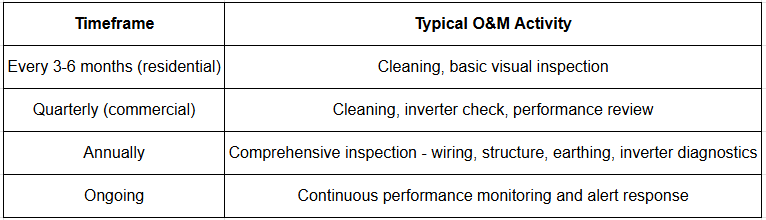
Quick Tip: Ask your O&M provider for a written annual maintenance schedule, rather than relying on informal or reactive visits – a documented plan makes it much easier to track what’s actually been done over the years.
Real-World Example: A System That Was Properly Maintained vs One That Wasn’t
Consider two similar homes, each with a 3kW system installed around the same time.
Home A received no scheduled maintenance after installation. Dust gradually accumulated, and a minor wiring connection loosened over time. By year two, their generation had noticeably declined, though they only discovered this when comparing bills against their first year – well after the savings had already been lost.
Home B had a proper solar maintenance services schedule – cleaning every few months and an annual comprehensive check. When a similar minor wiring issue developed, it was caught during a routine inspection and fixed quickly, before it meaningfully affected output.
Both systems started with identical equipment. The difference in long-term performance came entirely down to consistent O&M.
Commercial and Industrial O&M: What Changes at Scale
For businesses and industrial properties, solar plant maintenance typically becomes more structured and frequent, given the larger financial stakes involved.
Key differences at commercial/industrial scale:
- More frequent cleaning cycles, often monthly or quarterly depending on dust exposure
- Panel or string-level monitoring to quickly isolate issues across large installations
- Dedicated maintenance contracts with defined response times for faults
- Detailed performance reporting, often required for internal cost tracking or investor reporting
Quick Tip: For larger installations, even a small percentage drop in output represents a significant absolute financial loss – making proactive, scheduled solar operation and maintenance far more valuable than reactive repairs.
Common Mistakes People Make After Installation
- Assuming the installer’s job is done once the system is commissioned, without asking about ongoing O&M options.
- Skipping scheduled cleaning, especially in dusty or high-pollution areas where buildup happens faster than expected.
- Only checking performance when the electricity bill unexpectedly rises, rather than proactively monitoring.
- Not keeping maintenance records, which can complicate warranty claims later.
- Treating annual inspection as optional for smaller residential systems, when it meaningfully protects long-term performance regardless of size.
- Ignoring minor issues flagged during inspection, assuming they’ll resolve on their own.
Checklist: What to Confirm With Your Installer About O&M
- Does your installer offer ongoing O&M services, or does support end at commissioning?
- Is there a documented cleaning and inspection schedule?
- Does the plan include inverter health checks, not just panel cleaning?
- Will you receive maintenance records for warranty and performance tracking purposes?
- Is there a clear process for reporting and resolving issues quickly?
- Does the O&M plan scale appropriately if you expand your system later?
ROI Insight: Why O&M Is Part of Your Original Savings Calculation
When you first calculated your solar system’s expected payback period and long-term savings, that projection assumed the system would perform close to its rated capacity throughout its lifespan. Consistent solar O&M services are what actually make that assumption hold true – without them, gradual performance decline quietly erodes the exact savings your investment was built around.
Quick Tip: Think of O&M cost not as an added expense, but as protection for the ROI calculation you already made when deciding to go solar.
When Should You Contact a Solar Expert?
Reach out to an O&M provider if:
- Your installer didn’t clearly explain what happens after commissioning.
- You haven’t had your system inspected since installation.
- Your electricity bill has increased despite no major change in usage.
- You manage a commercial or industrial site and need a structured, documented maintenance plan.
- You want to understand what your system’s current performance looks like compared to its original baseline.
A quick assessment can reveal whether your system is being properly maintained – or quietly left to fend for itself.
FAQs
1. What exactly are solar O&M services? Solar O&M (Operation and Maintenance) services include ongoing performance monitoring plus scheduled cleaning, inspection, and repair activities designed to keep a solar system performing close to its expected output throughout its lifespan.
2. Does maintenance start immediately after installation, or later? Proper monitoring and baseline performance tracking should begin immediately after commissioning, with scheduled cleaning and inspection typically starting within the first few months.
3. How often should residential solar panels be cleaned and serviced? This depends on your location, but residential systems typically benefit from cleaning every 3-6 months, with more frequent servicing needed in dustier or high-pollution areas.
4. What happens if I skip solar panel maintenance service for a year or more? Skipping maintenance often leads to gradual, unnoticed performance decline from dust buildup, minor wiring wear, or inverter inefficiency, which can meaningfully reduce your expected savings over time.
5. Is O&M different for commercial and industrial solar plants compared to residential? Yes. Commercial and industrial operation and maintenance of solar power plants typically involves more frequent servicing, panel or string-level monitoring, and structured maintenance contracts, given the larger financial impact of underperformance at scale.
6. Does regular maintenance affect my solar system’s warranty? In some cases, yes. Many manufacturers require documented maintenance history to fully honor certain warranty claims, making consistent servicing important beyond just performance reasons.
7. How do I know if my solar system needs maintenance right now? Comparing your current generation against your system’s original baseline output, or against the same period last year, is a simple way to spot signs that maintenance may be needed.
8. What should a good solar maintenance services provider include in their plan? Look for scheduled cleaning, inverter health checks, wiring and structural inspection, documented maintenance records, and clear performance monitoring – not just occasional, informal visits.
Conclusion
Installation is only the beginning of your solar system’s story. What happens afterward – through consistent solar O&M services – determines whether your system performs close to its full potential for 20-25 years, or gradually underdelivers without you ever noticing why. From the first few weeks of baseline monitoring to years of scheduled cleaning, inspection, and inverter checks, proper O&M is what protects the exact savings calculation that made solar a smart decision in the first place.
Whether you own a small rooftop system or manage a large commercial or industrial installation, understanding what should happen after installation helps you ask the right questions – and get the long-term performance you were promised.
Ready for Complete Support After Your Solar Installation?
S’unlimited Solar‘s total service support covers everything from initial commissioning to ongoing cleaning, inspection, and performance monitoring – so your system keeps performing the way it should.
Request your free consultation today →
Get a clear O&M plan built around your system’s actual needs – with zero obligation.

Pournima
A content writer at S'unlimited with expertise in solar energy education, producing guides and insights that simplify complex industry concepts for homeowners and businesses.