
Rooftop Solar Subsidy in Maharashtra: Subsidised vs Self-Financed – Which Saves You More?

Rooftop Solar Subsidy in Maharashtra: Subsidy vs Self-Pay
If you’re planning to go solar in Maharashtra, you’ve probably run into two very different pieces of advice. One neighbour swears by the rooftop solar subsidy in Maharashtra and says it’s the only sensible way to install solar. Another tells you to skip the subsidy paperwork entirely and self-finance the system because “it’s faster and you get more freedom.”
So who’s right?
The honest answer: it depends on your roof, your budget, your electricity consumption, and how much time you’re willing to spend on approvals. In this guide, we’ll break down both routes in plain language – real numbers, real trade-offs – so you can decide what actually saves you more money, not just what sounds good in a sales pitch.
Quick question before we dive in: What’s your average monthly electricity bill right now? If it’s above ₹3,000–₹4,000, you’re likely sitting on strong solar savings potential, subsidy or not.
What Is the Rooftop Solar Subsidy in Maharashtra?
The rooftop solar subsidy in Maharashtra is primarily driven by the central government solar subsidy under the PM Surya Ghar: Muft Bijli Yojana. It’s a government solar scheme for home rooftop installations, designed to reduce the upfront cost for residential consumers.
On top of this, Maharashtra has periodically offered a state-level top-up subsidy for residential rooftop solar, which can add further savings depending on system size and scheme availability at the time of application.
Important: This Maharashtra government solar subsidy and the central subsidy are available almost exclusively to residential consumers. Businesses, industries, and commercial property owners are generally not eligible for direct subsidy under this scheme – though they benefit through accelerated depreciation, net metering, and long-term tax advantages instead.
Who Can Actually Claim This Subsidy?
To be eligible for solar subsidy in Maharashtra, you typically need to:
- Be a residential electricity consumer with a valid MSEDCL/BEST connection
- Have a shadow-free rooftop suitable for solar panel installation
- Use only MNRE-approved (ALMM-listed) panels and inverters
- Get the installation done through a registered/empanelled vendor
- Not have claimed a rooftop solar subsidy on the same property before
- Install a system within your sanctioned electrical load
Housing societies with common rooftop areas can also apply, subject to specific documentation.
Subsidised Solar: How It Works, Step by Step
Going the subsidised route means working within the government’s process. Here’s a simplified path:
- Register on the National Portal for Rooftop Solar with your electricity consumer number
- Get feasibility approval from MSEDCL/BEST
- Choose an empanelled vendor and finalize the system design
- Complete installation using ALMM-approved equipment
- Apply for and complete net metering installation
- Submit inspection report and commissioning certificate
- Subsidy is credited directly to your bank account post-commissioning
This entire solar panel licensing and approval process typically takes a few weeks to a couple of months, depending on how quickly your DISCOM processes approvals and how organized your documentation is.
Did You Know? Delays in the subsidised route are rarely caused by the subsidy itself – they usually happen because of incomplete documentation, wrong system sizing versus sanctioned load, or non-ALMM equipment being proposed by inexperienced vendors. Working with an experienced installer avoids 90% of these delays.
Pros of Subsidised Solar
- Lower upfront investment (subsidy directly reduces your cost)
- Faster payback period since your net investment is smaller
- Mandatory net metering approval as part of the process, which is a long-term benefit anyway
- Government-backed quality checks (ALMM-listed equipment only)
Cons of Subsidised Solar
- More paperwork and government approval timelines
- System size and equipment choices are somewhat restricted by scheme rules
- Only available to eligible residential consumers, not most businesses
- Subsidy disbursement can take time after commissioning
Not sure if your property qualifies for the current subsidy slab? Talk to our solar experts – we handle the entire application and licensing process for you.
Self-Financed Solar: How It Works
Self-financed simply means you pay the full system cost upfront (or through a personal/business loan) without applying for government subsidy. This is common among:
- Businesses and industries not eligible for the residential subsidy
- Commercial property owners who need larger systems the subsidy caps don’t cover
- Homeowners who want to move fast without waiting on approvals
- Those installing systems larger than what standard subsidy slabs support
Pros of Self-Financed Solar
- No dependency on government processing timelines
- Freedom to choose any capacity, brand, or configuration that fits your needs
- Faster installation start-to-finish, often within a few weeks
- Ideal for larger commercial/industrial loads where subsidy caps don’t apply anyway
Cons of Self-Financed Solar
- Higher upfront cost, since you’re not offsetting it with subsidy
- Longer payback period on paper (though savings over 25 years remain substantial)
- You still need proper approvals for net metering, even without subsidy
Subsidised vs Self-Financed: Real Cost Comparison
Let’s put actual numbers on the table for a 3 kW residential rooftop system, since that’s the most common size for a typical Maharashtra household.
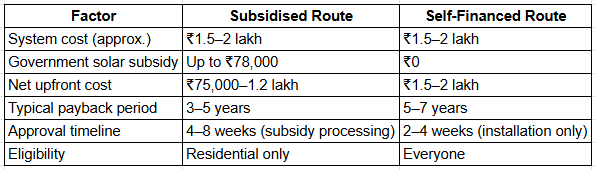
Real-world example: A household in Pune with a monthly bill of ₹4,500 installs a 3 kW system. With the subsidy, their net cost drops to roughly ₹1 lakh, and with average annual savings of ₹25,000–28,000, they recover their investment in about 4 years. The same household, self-financing the full ₹1.8 lakh, still breaks even in around 6–7 years – the system just takes a little longer to “pay for itself,” but the 25-year savings potential remains largely similar once the subsidy amount is fully offset over time.
The bottom line: For eligible homeowners, the subsidy route almost always saves more money simply because it reduces the amount you need to recover. For businesses and larger properties that can’t claim the subsidy anyway, self-financing isn’t a “loss” – it’s the only practical route, and the long-term ROI is still strong given Maharashtra’s high commercial electricity tariffs.
Which Option Is Right for You? A Quick Checklist
Ask yourself the following before deciding:
- Is my property a residential connection or commercial/industrial?
- Do I want a system size that fits within subsidy slabs (up to 3 kW+), or do I need a much larger capacity?
- Can I wait 1–2 months for subsidy processing, or do I need power savings starting immediately?
- Have I compared quotes from vendors who are MNRE-empanelled and ALMM-compliant?
- Do I understand my current electricity consumption pattern well enough to size the system correctly?
If you checked “residential” and “can wait a bit,” the subsidised route is almost always the smarter financial move. If you checked “commercial” or “need it fast and bigger,” self-financing (with proper planning) makes more sense.
Common Mistakes to Avoid
Whether you go subsidised or self-financed, these mistakes cost people real money:
- Oversizing or undersizing the system without analyzing actual monthly consumption
- Choosing non-ALMM equipment to save a little upfront, which can disqualify subsidy claims entirely
- Skipping net metering approval, which limits your ability to export surplus power and earn credits
- Using unregistered vendors who don’t understand the government solar subsidy application process
- Not comparing multiple quotes, leading to inflated system pricing
- Ignoring roof shadow analysis, which quietly reduces generation efficiency for years
Quick Tip: Always ask your vendor to show you their MNRE empanelment and past subsidy disbursement track record before signing anything. A vendor who can’t explain the government solar subsidy process clearly is a red flag.
When Should You Contact a Solar Expert?
You don’t need to have all the answers before reaching out – that’s literally what a consultation is for. But it’s especially worth talking to an expert if:
- You’re unsure whether your property qualifies for the Maharashtra government solar subsidy
- Your monthly bill fluctuates a lot and you need help right-sizing the system
- You run a business or industrial unit and want to understand net metering + tax benefits instead of subsidy
- You’ve already gotten quotes that seem inconsistent or confusing
- You want someone to handle the solar panel licensing, documentation, and DISCOM coordination on your behalf
At S’unlimited Solar, we handle the entire governmental approval and licensing process for our customers – from feasibility application to net metering commissioning – so you don’t have to chase paperwork yourself.
Get your free site survey and personalised quotation →
Frequently Asked Questions
1. What is the current rooftop solar subsidy in Maharashtra for homeowners? Residential consumers can receive up to ₹78,000 under the central government solar subsidy (PM Surya Ghar Muft Bijli Yojana) for systems of 3 kW or above, with lower slabs for 1 kW and 2 kW systems. A Maharashtra state top-up may also apply depending on current scheme availability.
2. Can businesses or industries claim solar panel subsidy in Maharashtra? Generally, no. The subsidy scheme is designed for residential rooftop installations. Businesses and industries typically benefit instead through accelerated depreciation, net metering credits, and reduced electricity costs over time.
3. Is self-financed solar a bad option if I’m eligible for subsidy? Not necessarily bad – just slower to break even. If you need a larger system than the subsidy caps support, or you can’t wait for approval timelines, self-financing lets you move faster and choose your own configuration.
4. How long does the government solar scheme for home approval process take? Typically 4–8 weeks from application to subsidy disbursement, depending on your DISCOM’s processing speed and how complete your documentation is.
5. Does self-financed solar still require net metering approval? Yes. Regardless of whether you take the subsidy, net metering approval from MSEDCL or BEST is required to legally export surplus power to the grid and receive billing credits.
6. What system size is best for a typical Maharashtra home? Most households with a monthly bill of ₹3,000–₹6,000 find a 3 kW system to be the sweet spot, as it maximizes the subsidy cap while comfortably covering daily consumption.
7. Can I lose my subsidy eligibility after installation? Yes, if you use non-ALMM equipment, work with a non-empanelled vendor, or exceed your sanctioned electrical load. This is why proper vendor selection matters as much as the subsidy amount itself.
8. Where can I get help with solar panel licensing and subsidy applications in Maharashtra? S’unlimited Solar manages the complete governmental procedure – feasibility approval, documentation, empanelled installation, and net metering – so your subsidy application goes through smoothly.
Conclusion: So, Which Actually Saves You More?
If you’re an eligible homeowner in Maharashtra, the rooftop solar subsidy in Maharashtra almost always comes out ahead financially – lower upfront cost, faster payback, and government-verified equipment quality. The trade-off is a slightly longer approval timeline.
If you’re a business, industry, or commercial property owner – or simply need a larger, faster installation – self-financed solar isn’t a compromise. It’s the practical path, and with Maharashtra’s rising electricity tariffs, the long-term ROI remains strong either way.
The real mistake isn’t choosing subsidy over self-financing (or vice versa) – it’s delaying the decision while your electricity bills keep climbing every month.
Ready to find out which option fits your property? Request a free consultation and site survey with S’unlimited Solar – we’ll assess your eligibility, calculate your real savings, and handle every bit of the government paperwork so you don’t have to.

Pournima
A content writer at S'unlimited with expertise in solar energy education, producing guides and insights that simplify complex industry concepts for homeowners and businesses.