
Solar Panel Subsidy Maharashtra: How Much Can You Really Save on Installation Cost
Solar Panel Subsidy Maharashtra: Real Savings 2026
“How much will I actually save?” – This is usually the first question homeowners and business owners ask once they hear about the solar panel subsidy Maharashtra offers. And it’s a fair question, because subsidy amounts, eligibility, and final savings often get lumped together in vague marketing claims.
The truth is, your savings depend on a few clear factors – your system size, your electricity consumption, whether you’re a homeowner or a business, and how the subsidy is calculated for your specific case.
In this blog, we’ll break down real numbers, real examples, and a clear picture of what solar panel subsidy actually means for your final installation cost – so you can evaluate solar with confidence, not guesswork.
Quick Answer: How Much Can You Save With Solar Panel Subsidy in Maharashtra?
For eligible residential systems, subsidy under the central government solar subsidy scheme can meaningfully reduce your upfront installation cost – often bringing down the effective cost per kW for smaller systems substantially compared to the unsubsidized price.
The exact percentage depends on:
- Your system size (subsidy structures often favor smaller systems proportionally)
- Whether you’re a residential or commercial customer
- Current subsidy rates, which are revised periodically by MNRE and state authorities
Quick Tip: Always ask your installer to show you the pre-subsidy and post-subsidy cost separately in your quote. If a quote only shows one final number, you can’t verify how much you’re actually saving.
Understanding How Solar Panel Subsidy Works in Maharashtra
Before we get into numbers, it helps to understand where the subsidy actually comes from.
- The central government solar subsidy is provided under the national rooftop solar program, aimed at encouraging residential adoption.
- The Maharashtra government solar subsidy works alongside this central scheme, and in some cases adds further state-level benefits.
- Subsidy is disbursed after installation and inspection are complete – not before.
- Only systems installed by empanelled installers (registered under proper solar panel licensing) qualify for subsidy disbursement.
Did You Know? Subsidy is typically calculated as a percentage of the benchmark cost set by the government for a given system size – not necessarily the exact price your installer quotes. This is why understanding benchmark pricing matters when evaluating your real savings.
Solar Panel Subsidy Maharashtra: Approximate Savings by System Size
Here’s a simplified way to think about how subsidy typically impacts different system sizes for residential customers. (Note: exact percentages and slabs are revised periodically – always confirm current rates before finalizing your decision.)
| System Size | Typical Use Case | Subsidy Impact |
| 1–2 kW | Small homes, low consumption | Highest subsidy benefit per kW |
| 3 kW | Average urban household | Strong subsidy benefit, most popular slab |
| 4–10 kW | Larger homes | Subsidy benefit tapers as system size increases |
| Above 10 kW | Larger homes/small businesses | Minimal to no direct subsidy; other benefits apply |
Ask yourself: What’s your average monthly electricity bill? If it’s consistently above ₹2,500–3,000, a 2–3 kW system is often the sweet spot where subsidy benefit and real consumption needs align well.
Real-World Example: What Savings Actually Look Like
Let’s take a practical example (illustrative, based on typical patterns – actual figures depend on current rates and site conditions):
A homeowner in Maharashtra with a monthly electricity bill of around ₹3,500 installs a 3kW rooftop solar system. Before subsidy, the system cost sits within a typical market range for a 3kW installation. After applying eligible central government solar subsidy and confirming eligibility for Maharashtra government solar subsidy, their effective upfront cost drops meaningfully – often bringing the payback period down to somewhere between 3.5 to 5 years, depending on final subsidy amount and electricity tariffs.
After that payback period, the homeowner continues to benefit from significantly reduced electricity bills for the remaining 20+ years of the system’s operational life.
Quick Tip: Payback period calculations should always be based on your actual consumption pattern and local DISCOM tariff – not a generic industry average.
Homeowners vs Businesses: How Subsidy Differs
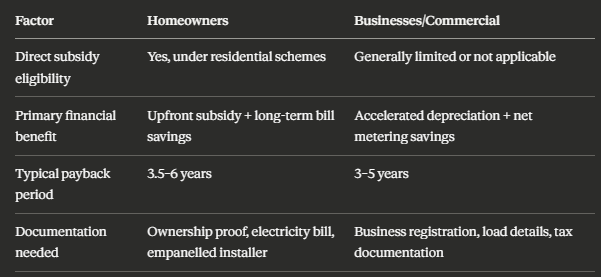
If you’re a business owner, don’t assume the absence of direct subsidy means solar isn’t worth it – the depreciation and operational savings often make commercial solar equally, if not more, financially attractive over time.
Common Mistakes That Reduce Your Actual Savings
- Assuming subsidy applies to the full quoted price, when it’s actually based on a government benchmark cost.
- Choosing a non-empanelled installer to save on upfront price, then losing subsidy eligibility entirely.
- Oversizing the system beyond actual consumption needs, reducing per-kW subsidy benefit.
- Not confirming current subsidy rates before finalizing, since rates are periodically revised.
- Ignoring the net metering step, which delays both grid connection and subsidy disbursement.
- Comparing only the pre-subsidy price across installers instead of the final, verified post-subsidy cost.
Checklist: How to Maximize Your Solar Panel Subsidy Savings
Before finalizing your installation, check:
- Is your installer empanelled under current solar panel licensing norms?
- Does your quote clearly separate pre-subsidy and post-subsidy cost?
- Have you confirmed the current subsidy slab for your intended system size?
- Is your system size aligned with your actual electricity consumption?
- Has your installer explained the net metering and disbursement timeline?
- Do you have written confirmation of the expected subsidy amount, not just a verbal estimate?
When Should You Contact a Solar Expert?
It’s worth speaking to a solar consultant if:
- You’re unsure how much subsidy actually applies to your specific system size.
- You’ve received different subsidy estimates from different installers.
- You want to compare your real payback period against your current electricity costs.
- You’re a business owner exploring whether depreciation benefits make more financial sense than waiting on subsidy schemes.
- You want written clarity on subsidy timelines before committing to installation.
A short conversation with an expert can help you avoid inflated savings claims and get a realistic picture based on your actual home or business.
FAQs
1. How much subsidy can I get under solar panel subsidy Maharashtra schemes?
Subsidy amounts depend on system size and current government slabs, which are revised periodically. Smaller residential systems (1–3 kW) typically see the highest proportional benefit.
2. Is Maharashtra government solar subsidy separate from central government solar subsidy?
They work together rather than as fully separate programs – the state-level scheme generally supplements the central subsidy rather than replacing it.
3. Do businesses get solar panel subsidy in Maharashtra?
Direct subsidy is primarily aimed at residential customers. Businesses typically benefit more through accelerated depreciation and net metering savings.
4. How long does it take to receive subsidy after installation?
Once installation, inspection, and net metering approval are complete, subsidy is usually disbursed within a few weeks, though timelines can vary by DISCOM.
5. Does subsidy apply to the price my installer quotes me?
Not exactly. Subsidy is typically calculated against a government-set benchmark cost, not necessarily your installer’s exact quoted price.
6. What size solar system gets the maximum subsidy benefit in Maharashtra?
Smaller systems, typically in the 1–3 kW range, generally see the highest subsidy benefit relative to system cost.
7. Can I lose my subsidy eligibility after installation?
Yes – if your installer isn’t properly empanelled, or if net metering and documentation steps aren’t completed correctly, subsidy can be delayed or denied even after installation.
8. Where can I check the current solar panel subsidy rates in Maharashtra?
Rates are periodically updated by MNRE and state nodal agencies. It’s best to confirm current rates directly with an empanelled installer before finalizing your decision.
Conclusion
Solar panel subsidy Maharashtra schemes can meaningfully lower your upfront solar investment – but only when you understand exactly how the subsidy is calculated, choose a properly empanelled installer, and complete every procedural step correctly. Real savings come from combining the right system size, accurate consumption assessment, and verified subsidy eligibility – not just the lowest quoted number.
Whether you’re a homeowner trying to reduce your electricity bill or a business exploring long-term operational savings, understanding these details upfront protects your investment and helps you plan with realistic expectations.
Ready to Find Out Your Real Solar Savings?
S’unlimited Solar helps you calculate your exact subsidy eligibility, expected savings, and payback period – based on your actual electricity bill and property, not generic estimates.
Request your free site survey and personalized quotation today →
Get complete clarity on your subsidy, savings, and next steps – with zero obligation.

Pournima
A content writer at S'unlimited with expertise in solar energy education, producing guides and insights that simplify complex industry concepts for homeowners and businesses.