
Who Actually Needs a Solar Panel License in India – Homeowner, Business, or Installer?

Who Needs Solar Panel Licensing in India?
If you’ve started researching rooftop solar, you’ve probably run into a confusing mix of terms – “license,” “approval,” “net metering,” “empanelment,” “subsidy registration.” It’s enough to make anyone pause before going solar.
Here’s the short answer: solar panel licensing in India doesn’t work the same way for everyone. A homeowner installing a 3kW system on their rooftop has very different obligations than a factory owner installing a 500kW system, or a company that wants to install and sell solar systems to others.
In this guide, we’ll break down exactly who needs what – whether you’re a homeowner in Pune, a business owner in Nagpur, or someone planning to become a solar installer – and how it connects to schemes like the central government solar subsidy and Maharashtra government solar subsidy.
By the end, you’ll know precisely what paperwork applies to you, and what you can safely ignore.
Quick Answer: Who Needs a License?
Here’s the straightforward version, before we go into detail:
- Homeowners don’t need a “license” – you need net metering approval and DISCOM registration, which your installer typically handles for you.
- Businesses and commercial property owners need net/gross metering approval, and depending on system size, may need additional electrical inspectorate clearances.
- Solar installers and vendors need to be empanelled with the state nodal agency (like MEDA in Maharashtra) and registered under relevant government schemes to legally install subsidised systems.
Quick Tip: If you’re a homeowner or business owner, you’re not the one who needs to be “licensed” – your installer does. Your job is to make sure you’re working with a properly empanelled installer, which directly affects whether you’re eligible for subsidy.
Understanding “Solar Panel Licensing” in India
The term “license” gets used loosely, but in India’s solar ecosystem, it really refers to a few distinct things:
- DISCOM approval – permission from your local electricity distribution company to connect your solar system to the grid.
- Net metering registration – the mechanism that lets you export excess solar power to the grid and get credited on your bill.
- Vendor/installer empanelment – official registration of a solar company with a state or central nodal agency, allowing them to install subsidy-eligible systems.
- Electrical safety approvals – required for larger systems, particularly in commercial and industrial setups.
Did You Know? Under India’s national rooftop solar program, only empanelled vendors are authorised to install systems that qualify for the central government solar subsidy. Installing with a non-empanelled vendor can mean losing your subsidy entirely – even if the installation itself is technically sound.
This is exactly why understanding who needs what matters – get it wrong, and you either delay your project or lose money you were entitled to.
Homeowners: What You Actually Need
If you’re a residential customer, here’s the good news: you don’t personally need a solar panel license. What you need is a compliant installation process.
Steps for homeowners:
- Choose an empanelled installer – this is non-negotiable if you want the government solar scheme for home subsidy.
- Apply for net metering through your DISCOM (this is usually done by your installer on your behalf).
- Get your system inspected and approved before it’s connected to the grid.
- Receive subsidy disbursement directly into your bank account once installation and inspection are complete.
Ask yourself:
- What’s your average monthly electricity bill right now?
- Does your rooftop get 4–6 hours of direct sunlight daily?
- Is your roof structurally sound for panel installation?
If your monthly bill is consistently above ₹2,000–3,000, solar is very likely to pay for itself faster than you’d expect – especially with subsidy support.
Businesses & Commercial Property Owners: What You Need
Commercial solar works differently from residential. Businesses typically install larger systems, and the approvals scale accordingly.
What’s required:
- Gross or net metering approval depending on system capacity and DISCOM rules.
- Load sanction verification – your existing electricity connection load needs to support the new solar capacity.
- Structural and electrical safety clearance for systems above certain thresholds.
- In some cases, open access approvals if you’re setting up larger systems that feed excess power to the grid commercially.
Quick Tip:
Commercial subsidy structures differ from residential ones. While homeowners get direct subsidy under schemes tied to the central government solar subsidy, businesses often benefit more through accelerated depreciation and net metering savings rather than direct subsidy.
Checklist before you commit to commercial solar:
- Have you reviewed your last 12 months of electricity bills?
- Do you own the property, or will you need landlord approval?
- Is your roof/land area sufficient for your target capacity?
- Have you confirmed your installer is empanelled and experienced with commercial-scale projects?
Industries: Large-Scale Solar Requirements
For industrial units, licensing requirements get more layered, particularly for systems above 1MW or when using open access to source cheaper solar power from a third-party plant.
Industries typically need:
- Electrical Inspectorate approval for high-capacity installations.
- Open access permissions (if applicable) from the state electricity regulatory commission.
- Environmental clearances in specific cases, depending on land use and system size.
- Power Purchase Agreements (PPAs) if opting for third-party or captive solar models instead of direct rooftop ownership.
Real-world example:
A mid-sized textile unit in Maharashtra with a monthly electricity bill of ₹4–5 lakhs can typically offset 40–60% of consumption with a well-sized rooftop or ground-mounted system, alongside significant tax benefits through depreciation – on top of long-term savings from reduced grid dependence.
Quick Tip: Industrial solar decisions should always start with a load and consumption audit. Sizing the system incorrectly is one of the costliest mistakes industries make.
Solar Installers & Vendors: Licensing Requirements
If you’re on the other side – planning to become a solar installer or vendor – this is where “licensing” in the truest sense applies.
Requirements for installers:
- Empanelment with the state nodal agency (MEDA in Maharashtra, or equivalent bodies in other states).
- Registration under the national rooftop solar portal to install subsidy-linked systems.
- Certified technical manpower – trained and certified installers as per MNRE (Ministry of New and Renewable Energy) guidelines.
- Compliance with BIS-approved equipment standards – only using panels and inverters that meet quality benchmarks.
- Business registration and GST compliance, standard for any registered vendor.
Without empanelment, an installer simply cannot offer subsidy-linked installations – which is a major reason homeowners and businesses should always verify this before signing a contract.
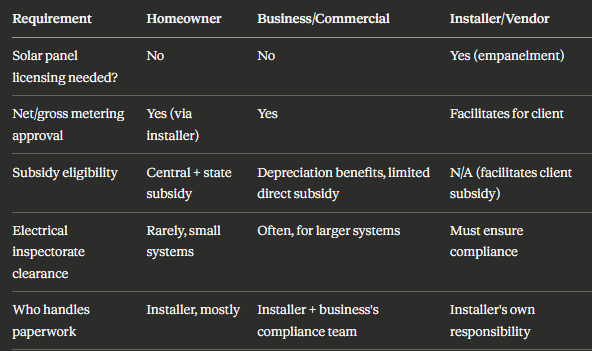
Comparison Table: Homeowner vs Business vs Installer
How Licensing Connects to Government Solar Subsidies
This is where most confusion happens – people assume subsidy and licensing are separate issues. They’re not.
Here’s the connection:
- The central government solar subsidy is only released for systems installed by empanelled vendors registered under the national rooftop solar scheme.
- Maharashtra government solar subsidy and solar panel subsidy Maharashtra programs work in tandem with the central scheme – state-level incentives often supplement, rather than replace, central benefits.
- If your installer isn’t properly registered, you could complete the entire installation and still be denied subsidy disbursement.
Did You Know? Depending on system size, eligible homeowners can receive subsidy support that meaningfully lowers upfront costs under the government solar scheme for home – but only if every procedural step, from vendor empanelment to net metering, is followed correctly.
This is precisely the kind of process S’unlimited Solar handles end-to-end for customers – see our detailed breakdown of the governmental procedures for solar licensing.
Common Mistakes People Make
- Assuming any local vendor can get you a subsidy – only empanelled vendors qualify.
- Skipping net metering registration – leads to grid connection delays or rejection.
- Undersizing or oversizing the system without a proper consumption audit.
- Not checking DISCOM-specific rules – requirements can vary slightly across Maharashtra’s distribution zones.
- Delaying inspection approvals, which pushes back subsidy disbursement timelines.
- Confusing state and central subsidy schemes, leading to incorrect expectations on total savings.
When Should You Contact a Solar Expert?
You should reach out to a solar consultant if:
- You’re unsure whether your roof or property qualifies for solar.
- You don’t know which subsidy scheme (central, state, or both) applies to your situation.
- You’ve received conflicting information from different vendors.
- You want an accurate ROI estimate based on your actual electricity usage, not a generic quote.
- You’re a business or industry considering open access or third-party PPA models.
A short consultation upfront can save weeks of back-and-forth paperwork later – and ensure you don’t lose out on subsidy eligibility due to a licensing gap.
FAQs
1. Do homeowners need a solar panel license in India? No. Homeowners don’t need a personal license. You need net metering approval from your DISCOM, which your installer typically manages for you.
2. Who actually needs solar panel licensing in India? Solar installers and vendors need licensing in the form of empanelment with state or central nodal agencies. Homeowners and businesses need approvals like net metering, not a license themselves.
3. How does solar panel licensing affect my subsidy eligibility? Subsidy under schemes like the central government solar subsidy is only disbursed when installation is done by an empanelled vendor. Unlicensed vendors can’t offer subsidy-linked systems.
4. Is the Maharashtra government solar subsidy separate from the central subsidy? They typically work together – the Maharashtra government solar subsidy often supplements the central scheme rather than functioning as a completely separate program. Exact structures can change, so it’s worth confirming current rates before installation.
5. What documents does my installer need to show me? Ask for proof of MNRE/state nodal agency empanelment, GST registration, and past project references before signing any contract.
6. Can businesses get the rooftop solar subsidy in Maharashtra? Direct subsidy is primarily aimed at residential systems. Businesses generally benefit more from accelerated depreciation, net metering savings, and lower operating costs rather than direct subsidy.
7. How long does the licensing and approval process take? For homeowners, net metering approval typically takes a few weeks after installation, depending on your DISCOM’s processing time. Commercial and industrial approvals can take longer due to additional clearances.
8. What happens if I install solar without proper approvals? You may face grid connection delays, inspection failures, or – most critically – lose eligibility for government subsidy altogether.
Conclusion
Solar panel licensing in India isn’t a single, one-size-fits-all requirement. Homeowners need approvals, not licenses. Businesses need metering clearances and compliance documentation. Industries face more layered regulatory steps. And installers are the ones who genuinely need to be licensed and empanelled.
The real takeaway? Whether you’re going solar for your home, business, or industrial unit, the smoothest path to subsidy and grid approval is working with a vendor who already understands – and handles – this entire process for you.
Ready to Go Solar the Right Way?
Don’t let paperwork or licensing confusion slow down your solar journey. S’unlimited Solar is an empanelled installer with proven experience navigating central and Maharashtra government solar subsidy schemes for homeowners, businesses, and industries alike.
Request your free site survey and personalised quotation today →
Get clarity on your eligibility, your savings potential, and your exact next steps – with zero obligation.

Pournima
A content writer at S'unlimited with expertise in solar energy education, producing guides and insights that simplify complex industry concepts for homeowners and businesses.